
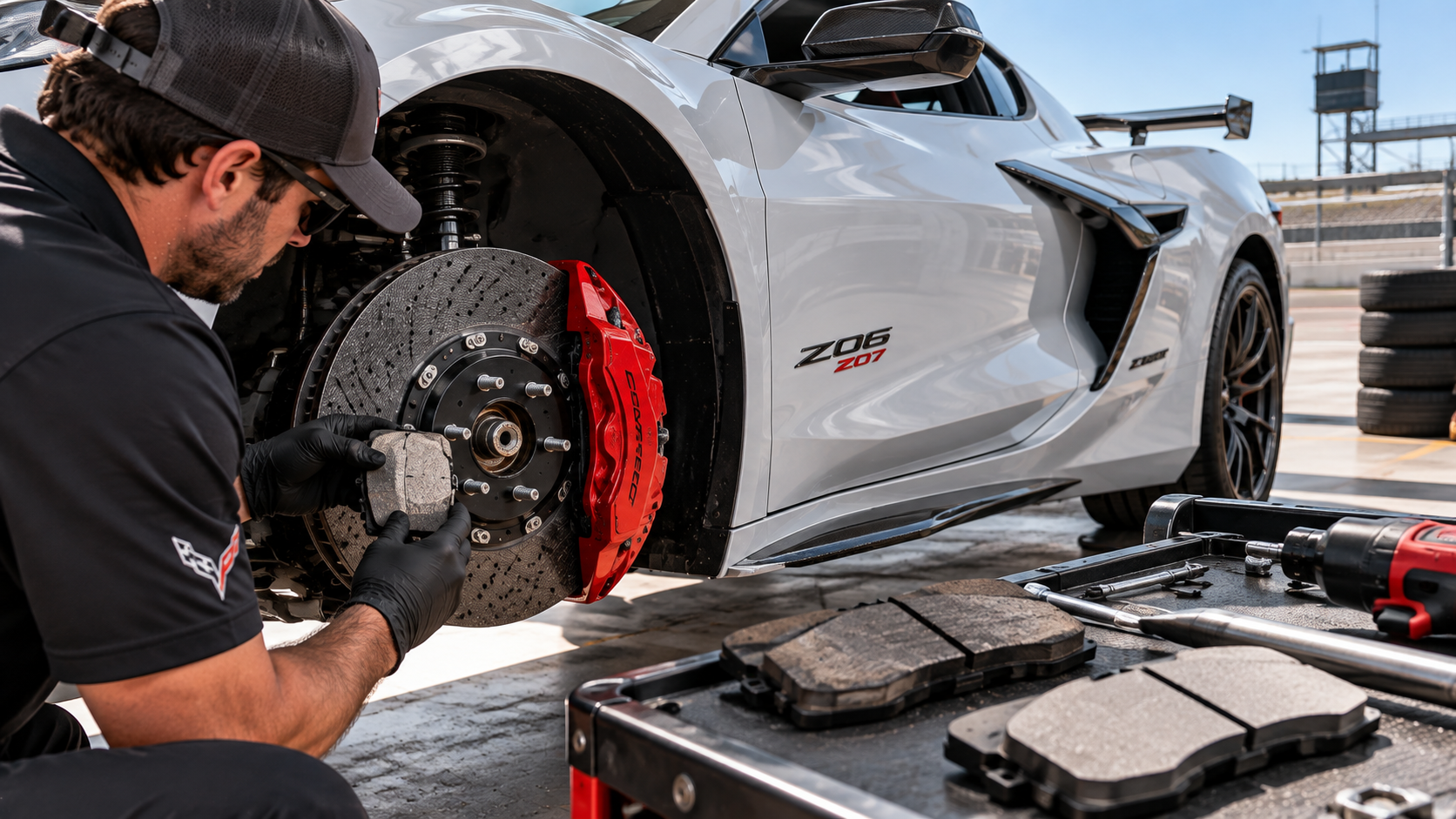
Corvette Z07 brake hardware shows why pad compound selection matters once repeated track braking raises temperatures far beyond street driving. A pad that feels strong during normal road use may lose friction after several hard braking zones. Therefore, compound choice should start with heat range, rotor material, and the car's track schedule. The right decision also considers cold response, pedal feel, dust, and wear between track events.
Why Track Heat Changes Brake Pad Response
Brake pads create friction against the rotor and convert vehicle motion into heat. During a street drive, the brakes usually receive more cooling time between hard stops. On track, repeated braking zones add heat before the pad and rotor can shed the prior load. Therefore, the friction material can move outside its preferred temperature range.
Why can a street pad feel strong at first and then fade several laps later? Pad fade is a drop in friction after the compound becomes too hot for its intended range. The pedal may still feel firm while stopping force falls. Therefore, a driver may press harder to achieve the same deceleration.
Furthermore, a high temperature compound uses friction material that stays stable at hotter rotor and pad temperatures. However, that does not make every race pad suitable for every Corvette. Rotor construction, track pace, session length, and street miles still matter.
For a Corvette Z07, heat management deserves close attention because repeated track braking can be severe. Ross Downing Corvettes explains the factory Corvette Z06 and Z07 details. That factory setup gives owners an important starting point before changing pad material.
Track heat should be reviewed through three separate questions:
- How hot do the pads and rotors become during the driver's normal session length?
- Does friction stay steady from the first hard stop through the final braking zone?
- Does the selected compound match the exact rotor material installed on the Corvette?
Therefore, pad selection begins with thermal demand, not a claim that one compound is simply stronger.
What a High Temperature Compound Changes
A higher temperature compound changes more than fade resistance. It can also change initial bite, pedal modulation, release feel, noise, dust, and wear. Therefore, track pad selection should compare several traits at once.
Initial bite describes how quickly braking force rises when the pad first meets the rotor. A more aggressive compound can deliver a sharper response early in pedal travel. However, strong bite alone does not define a good track pad.
Modulation describes how precisely the driver can add or reduce braking force through pedal pressure. That matters during corner entry because the driver may need fine control while reducing speed. Therefore, predictable response across the pedal range can matter as much as the first bite.
High temperature compounds also aim to keep friction more stable through repeated heat cycles. That stability reduces the drop in braking force associated with pad fade. In addition, the driver can judge braking points more accurately when pedal response stays familiar.
When comparing compounds, review these traits together:
- Initial bite should match how quickly you want braking force to build at pedal application.
- Modulation should let you add and release braking force without abrupt changes near corner entry.
- Heat range should fit the temperatures produced by your track pace and session length.
Furthermore, a compound with a very high heat range may be unnecessary for a lightly driven track car. The selection should match the actual use of the Corvette.
Chevrolet also pairs the Z06 braking package with a track focused chassis. Pad choice should respect that hardware instead of treating the pad as an isolated upgrade.
What Changes When the Same Corvette Returns to the Street
A Corvette driven to and from the track needs a different compromise from a trailered track car. High temperature pads can respond differently before they reach their preferred heat range. Therefore, cold response deserves review before installing a race focused compound.
What changes on the street when the pad was chosen for sustained track heat? Cold friction may feel less immediate until the pad warms. Noise can also increase, and brake dust may collect faster on the wheels.
Dust comes from friction material and rotor wear during braking. A more aggressive track compound can shed more material during hard use. Therefore, wheel cleaning may become a more frequent task.
Noise can rise for several reasons, including compound composition, pad shape, rotor surface, and operating temperature. However, noise alone does not prove that the brakes have a mechanical fault.
Street use also adds long periods where the brakes remain relatively cool. A dual use Corvette needs a pad that still gives suitable response during those cooler miles. Therefore, the hottest available compound may not fit a car that spends most days on public roads.
A dual use owner should weigh three points:
- Cold response matters when the Corvette leaves home before any heat reaches the brakes.
- Dust and noise matter more when the same car sees regular street miles between track events.
- Pad and rotor wear should be checked after track sessions before the next road trip.
Consequently, a dedicated track car can accept compromises that may annoy a driver during daily road miles.
Match the Pad Compound to Z07 Brake Hardware
Moreover, confirm rotor material before choosing any replacement pad. The Corvette Z07 package can include carbon ceramic Brembo brakes. Those rotors require pads approved for carbon ceramic use.
Can any track pad be installed on a Z07? No. Some aftermarket racing compounds are approved only for iron or metal rotors.
That restriction matters because pad material and rotor material create a matched friction pair. The wrong pairing can produce poor braking, rapid wear, or rotor damage. Therefore, a compound should never be chosen from temperature range alone.
Carbon ceramic rotors also respond differently to heat and wear than traditional iron rotors. The factory Z07 brake package uses that rotor material as part of its track focused setup. Therefore, owners should confirm exact rotor construction before ordering pads.
Before installation, verify the following:
- Confirm whether the Corvette uses iron rotors or carbon ceramic rotors.
- Confirm that the pad maker approves the compound for that exact rotor material.
- Confirm that pad thickness, shape, hardware, and axle position match the specific Corvette brake package.
Furthermore, changing pads may require a proper burnishing procedure before hard laps. Burnishing lays down a stable transfer layer between the pad and rotor surface. That process supports consistent friction once the brakes reach track temperatures.
Build the Pad Choice Around Your Track Routine
The best track pad decision starts with how the Corvette is used at the circuit and away from it. Session length, braking intensity, cooling time, and road miles all shape the choice.
Track cooling remains part of that plan. Higher temperature pads do not replace airflow through brake ducts or proper cooldown laps. Therefore, duct openings should stay clear, and factory track preparation guidance should be followed.
Pad inspection also belongs in the routine. Check remaining material before each event and inspect wear across the pad face. In addition, review the rotor surface for cracking, scoring, or other unusual marks.
A driver who attends one or two moderate track days may need a different compound from a frequent advanced driver. Similarly, a trailered Corvette can tolerate a more race focused pad than a car driven hundreds of street miles.
Ross Downing Corvettes also provides Corvette ordering information for owners planning a new track focused configuration. That page gives another route for discussing factory brake hardware before the car is ordered.
High temperature brake pads are not a shortcut around heat management. They are one part of a larger braking setup that includes rotors, fluid, cooling, burnishing, and inspection. Choose the compound around rotor compatibility and the temperatures your sessions create. Then account for the cold miles, dust, noise, and wear that come after the track day.