

Do Corvettes Have Engines in the Back? What Changes
Yes, the current Corvette does have its engine in the back. Starting with the 2020 model year, Chevy moved away from decades of front engine design. This guide explains why that switch happened and breaks each change down clearly. It also covers what changes in traffic and parking, and what a driver coming from an older Corvette should expect.

Do Corvettes Have Engines in the Back?
The direct answer is yes, but only since the C8 generation. Every Corvette built before 2020 placed the engine up front, behind the grille and ahead of the driver. That layout had stayed consistent across nearly seven decades of Corvette generations. The C8 moved that V8 behind the driver and ahead of the rear axle. This layout is known as mid engine. However, the shift was not cosmetic. It changed where weight sits across the chassis. Because the engine now sits closer to the car’s center, the car balances differently through a corner. That balance shift is the main engineering reason behind the move, and it shapes nearly every other change discussed in this guide.
Read the rest of this entry »Corvette Repair Shop Communication: What to Expect
A repair visit can feel uncertain even when nothing about the car itself is going wrong. A trustworthy corvette repair shop removes that uncertainty with clear updates. Those updates should run from the first phone call through pickup. Most service frustration traces back to silence during the wait. It rarely traces back to the quality of the work performed. This guide breaks down what clear communication should sound like at intake. It also covers diagnosis, timing shifts, and approval before added cost. Each stage builds on the one before it, and a gap early in the process usually carries forward to the next.
Why Do Service Visits Feel Stressful Even When the Repair Goes Fine?
This question matters because the stress rarely comes from the repair itself. Instead, it comes from not knowing what is happening to the car while it sits out of sight. Owners hand over a car and then wait without a clear sense of where it stands in the queue. As a result, even a routine wait can feel longer than it really is. Because most shops call only when something changes, the gap between updates can feel longer than it is. A shop that sets a clear contact schedule from the start removes that gap before it turns into frustration. For this reason, the first call at intake should state when the next update will arrive. It should not only confirm the drop off.
Read the rest of this entry »A Corvette driven hard on a track faces stress levels far beyond daily street use. For that reason, corvette specific service matters more than a routine oil change. Track driving raises brake temperatures and loads suspension bushings hard. Additionally, it cycles tires through heat ranges a daily commute never reaches. A shop that understands these stresses can catch wear before it causes a failure. This guide covers what to check before a track day. It also covers what changes mechanically on track, what to inspect right after, and why brake fluid choice carries real weight.

What Changes Mechanically During a Track Session?
This question matters because the answer explains every inspection point that follows. On track, brake rotors and pads reach temperatures far above street driving. Repeated hard stops can push that heat above 1,000 degrees Fahrenheit. That heat transfers into the brake fluid inside the calipers. If the fluid boils, the pedal can go soft or fail entirely. At the same time, suspension bushings and ball joints absorb cornering loads that exceed anything found on a public road. Tires heat cycle several times per session, and that changes both pressure and grip. Because these stresses build across a full track day, the car needs an inspection process that matches what it absorbed.
Read the rest of this entry »The Corvette Stingray and the Z06 share a body and a mid engine layout. They also share a badge that draws comparison the moment research begins. Corvette Stingray specs put the V8 at 490 horsepower. The Z06 pushes a flat plane crank V8 to 670 horsepower. That gap is the first number most shoppers find. However, a spec sheet only tells part of the story. The real question is whether that extra output changes how the car gets driven on a normal week. This guide breaks down the engine difference, the price gap, and the daily feel. The goal is a decision based on fit, not on the larger number printed on a window sticker.

The Engine Architecture Behind the Numbers
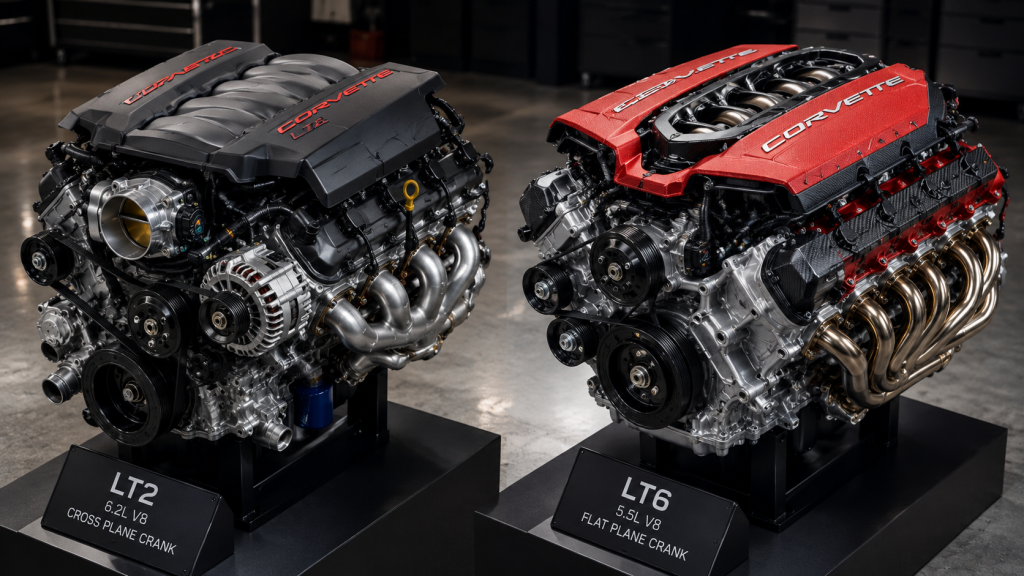
The Stingray runs a cross plane crank 6.2 liter V8. This layout produces smooth low end torque and a familiar V8 sound. The Z06 instead uses a flat plane crank 5.5 liter V8, a layout borrowed from race engineering. That design lets the engine spin past 8,000 RPM. Because the flat plane design favors high RPM output, the Z06 needs to be driven harder to show its full character. That changes how it feels in stop and go traffic. By contrast, the Stingray’s cross plane V8 delivers strong torque from idle. It feels responsive without needing high RPM to reward the driver. For a shopper who drives mostly on city streets, the Stingray’s engine layout matches that daily use. Given that most owners drive on public roads instead of a track, this distinction carries real weight.
Read the rest of this entry »LT2 vs LT6 Corvette Engine Differences Explained
The LT2 vs LT6 Corvette engine discussion starts long before horsepower numbers enter the conversation, because these two V8 layouts change how the car sounds, reacts, shifts, and communicates with the driver. Buyers researching the Corvette Stingray and Corvette Z06 usually begin with output figures, quarter mile times, or trim comparisons, but the larger distinction comes from engine architecture itself. Chevrolet engineered these powerplants with completely different personalities in mind. One delivers immediate torque with a deep, muscular cadence. The other builds intensity through rev speed, airflow, and razor-sharp response. Understanding how those traits appear behind the wheel creates a much clearer picture of which Corvette belongs in your garage.
Why LT2 and LT6 Feel Different Before Full Throttle
The LT2 in the Corvette Stingray uses a traditional cross plane crankshaft pushrod V8 layout. That configuration creates a smoother idle character, stronger low RPM torque delivery, and a heavier exhaust pulse rhythm. Even before aggressive acceleration, the Stingray feels settled and substantial. Small throttle inputs create immediate forward movement because torque arrives earlier in the rev range.
The LT6 in the Corvette Z06 approaches engine response very differently. Chevrolet developed this naturally aspirated 5.5 liter V8 around rapid airflow movement and high RPM breathing. Instead of emphasizing low-speed shove, the LT6 builds urgency through rev speed and throttle sharpness. Press the accelerator lightly in a Z06 and the engine climbs through RPM far faster than the Stingray. Drivers notice that change immediately during merges, lane changes, and corner exits.
That difference alters how the dual clutch transmission behaves as well. The Stingray transmission tuning keeps shifts calm and relaxed during casual driving. Gear changes happen lower in the RPM range because the LT2 produces strong usable torque without needing aggressive downshifts.
The Z06 behaves differently because the LT6 wants to remain active higher in the rev range.
Drivers may notice:
Read the rest of this entry »Corvette order updates can feel confusing once production timing, shipping windows, or delivery estimates begin to shift after your build is submitted. Many buyers enter the process expecting a straight path from order placement to dealership arrival, but the reality involves allocation scheduling, production sequencing, carrier coordination, and regional transport staging. That complexity becomes more noticeable with high demand configurations like the Corvette Z06, E Ray, or heavily optioned Stingray builds. The frustration usually comes less from the delay itself and more from uncertainty surrounding what is happening behind the scenes. Understanding how the process works gives buyers a better framework for interpreting updates and maintaining realistic expectations while the car moves through production and delivery.
Understanding Corvette Order Milestones After Submission
A Corvette order moves through several internal milestones before the vehicle ever reaches transport staging. The process begins with dealership allocation. Allocation refers to the number of Corvette builds Chevrolet authorizes a dealership to submit within a production cycle. Until allocation exists, a configuration may remain visible inside the system without receiving formal production scheduling.
Once the build receives allocation, the order moves through status progression tied to production planning. This stage determines when the vehicle enters sequencing for assembly at Bowling Green. Buyers following Corvette order updates usually begin paying close attention once the build receives target production timing.
The progression matters because different milestones represent very different stages:
Read the rest of this entry »Corvette Museum Delivery vs Standard Pickup Guide
Corvette Museum Delivery has become part of the ownership story for many C8 buyers, but the right acquisition path depends less on prestige and more on how you personally connect to the car before the first drive home. Some owners want the moment to feel immersive from the beginning, complete with plant history, museum orientation, and delivery ceremony. Others want a cleaner process centered around getting behind the wheel as quickly as possible. That difference shapes how buyers approach ordering, build tracking, scheduling, and even how they remember the car years later. A Corvette purchase is emotional by nature, so the acquisition path deserves the same level of consideration as trim selection, engine choice, or package configuration.

Why Corvette Buyers Approach Delivery Differently
The reason Corvette Museum Delivery generates so much attention is because the car itself carries enthusiast identity long before ownership begins. Buyers are not simply choosing transportation. They are entering a community with strong ties to engineering history, motorsports heritage, and personalization culture. That changes how acquisition decisions are viewed.
Some buyers treat delivery as the final administrative step before driving home. Others see it as the opening chapter of ownership itself. That distinction explains why Museum Delivery resonates strongly with some Corvette customers while feeling unnecessary to others.
Buyers leaning toward the Bowling Green route usually value:
Read the rest of this entry »Do Corvettes hold their value better than most sports cars? That question follows almost every buyer researching a Stingray, Z06, or E Ray because configuration choices start shaping future buyer demand long before the first mile is driven. Corvette resale patterns work differently than many performance cars because demand comes from several buyer groups at once. Enthusiasts chase specific engines and packages, collectors watch production numbers, and casual sports car buyers search for recognizable configurations that feel exciting without becoming difficult to own. That combination creates a market where trim selection, options, and even color combinations can influence future desirability years after production ends.

Why Corvette Value Retention Works Differently
Most sports cars lose value steadily because production volume eventually outpaces demand. Corvette pricing moves differently because the car carries both enthusiast and cultural recognition. A buyer searching for a used C8 is not simply shopping for transportation. They are usually shopping for a specific driving identity, engine layout, or ownership milestone.
The mid engine layout changed this dynamic even further. Earlier Corvette generations already carried strong enthusiast followings, but the C8 platform introduced entirely new buyer audiences who previously looked at European exotics or higher-priced performance coupes. That widened demand across the used market and created stronger long-term buyer visibility.
Production constraints also shape pricing stability. During periods where factory output slows or specialty trims become difficult to source, used inventory becomes more attractive because buyers can avoid waiting lists or allocation uncertainty. That creates unusual pricing support compared with ordinary sports car depreciation curves.
Several factors continue strengthening Corvette buyer interest:
Read the rest of this entry »Ordering a Corvette is not a single step. It is a structured process that moves through defined stages, each tracked by a specific status code. Most buyers are not just asking what these codes mean. They are trying to understand whether their order is progressing normally, how long each stage will take, and what happens next. The Corvette ordering system is designed to track production from initial request through delivery, but without context, those codes can feel unclear. Understanding how the system works allows you to interpret progress and set realistic expectations.

This approach reflects Chevrolet’s focus on clarity, real-world understanding, and helping drivers move forward with confidence
What Corvette Order Status Codes Actually Represent
When buyers ask what Corvette order status codes actually mean, they are asking how the production system tracks progress. Status codes are milestones that represent specific points in the manufacturing and ordering process.
Each Corvette order moves through a sequence of stages, beginning with initial entry into the order system and ending with delivery. These codes are not arbitrary labels. They indicate whether the order has been accepted, scheduled, built, or shipped.
For example, early-stage codes represent orders that are placed but not yet scheduled for production. Mid-stage codes indicate that the order has been accepted and assigned to a production cycle. Later-stage codes reflect that the vehicle is being built or prepared for shipment.
Read the rest of this entry »Buying a Corvette is not the same as purchasing a typical vehicle from inventory. Most shoppers are not just asking how to buy a Corvette. They are trying to understand what the process should feel like before they commit to a deposit. That process is structured around allocation, ordering systems, and dealership communication. When those systems are explained clearly, the experience feels controlled and predictable. When they are not, the same process can feel uncertain. Understanding how the Corvette buying system works allows you to evaluate the dealership experience before you commit.

This approach aligns with Chevrolet’s voice of being practical, clear, and focused on real-world confidence in decision-making
What the Corvette Buying Process Actually Involves Before a Deposit
When shoppers ask what the Corvette buying process should look like before placing a deposit, they are asking how the system moves from interest to commitment. The Corvette purchase process is not based on immediate inventory selection. It is based on securing a future production slot through an order system.
Before a deposit is placed, the dealership should walk you through how ordering works, how allocations are assigned, and how your build request fits into that system. A deposit is not simply holding a vehicle. It is securing a position in a sequence that determines when your Corvette will be built.
At this stage, clarity should include:
Read the rest of this entry »Connect with us
