

What year did Corvette go to mid engine? The change arrived with the 2020 Corvette Stingray, revealed in July 2019. Both dates appear in Corvette history because they mark different points. Chevrolet showed the C8 during 2019, then released it for the 2020 model year.
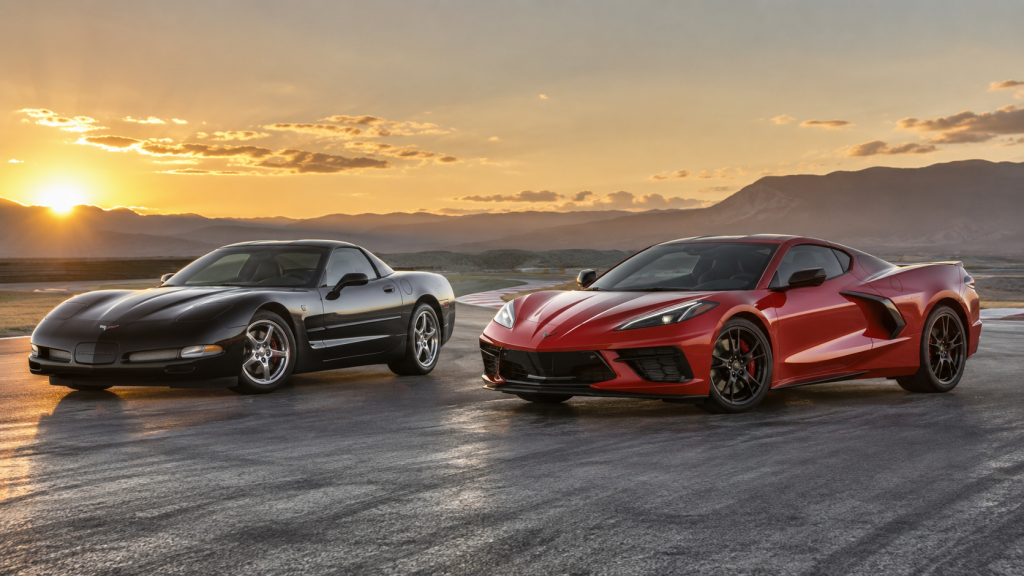
That answer gives you the date, but the engineering story reaches much farther back. Chevrolet had studied rearward engine placement for decades. Therefore, the C8 was not a sudden rejection of Corvette history. It brought a long running idea into regular production.
When Corvette Became Mid Engine
The C7 closed Corvette’s front engine production chapter after the 2019 model year. Then, Chevrolet introduced the eighth generation Stingray with its V8 behind the passenger compartment. Therefore, the new car carried a 2020 model year designation.
Why do some sources say 2019 while others say 2020? Chevrolet unveiled the car on July 18, 2019. However, dealerships received it as a 2020 Corvette Stingray. Thus, 2019 marks the public reveal, while 2020 identifies the first production model year.
Generation names also make the timeline easier to follow. C7 refers to the seventh generation, which kept its engine ahead of the cabin. C8 identifies the eighth generation and its new engine position.
Furthermore, the change reshaped the car’s proportions. The cabin moved forward, while the rear body gained space for the V8 and transaxle. Even so, the C8 remained a two seat Chevrolet sports car.
Where the C8 Corvette Engine Sits
Is the C8 engine in the middle or the back? It sits behind the seats and ahead of the rear axle. That placement makes the Corvette a rear mid engine car.
A rear engine car places its engine behind the rear axle. By contrast, the C8 keeps the V8 within the wheelbase. The engine sits near the car’s center, although it remains behind the passenger compartment.
This distinction matters because axle position shapes how mass rests on the tires. Moving the V8 rearward places more static weight near the driven rear wheels. Therefore, the rear tires begin with more load before acceleration starts.
In addition, the transaxle sits at the rear. It combines the transmission and final drive near the engine. As a result, the main powertrain mass stays close to the rear axle and within the wheelbase.
You can identify the layout through four basic points:
- The passenger cabin sits ahead of the engine.
- The V8 sits ahead of the rear axle.
- The rear wheels receive power in the Stingray.
- The transmission and final drive sit near the engine.
Together, these points explain why the C8 is called rear mid engine. The name refers to engine position, not the visual center of the body.
Why Did Chevrolet Move the Corvette Engine?
Chevrolet moved the engine to place more mass near the tires delivering power. During hard acceleration, weight also shifts toward the rear axle. Therefore, the C8 starts with rearward mass and gains more rear load as it launches.
Why did that matter after seven front engine generations? Engine output kept rising, yet tire grip remained finite. A front engine layout places substantial static weight over the front axle. The rear tires must then handle growing torque with less starting load above them.
Wheelspin wastes part of the force meant to move the car. By moving the V8 rearward, Chevrolet gave the rear contact patches a stronger starting point. Consequently, the C8 could use its available engine output more effectively during a launch.
Braking also entered the engineering case. Hard braking transfers load toward the front axle, regardless of engine position. However, rearward static mass leaves more load at the rear as that transfer occurs. The rear brakes can then carry a larger share of the stopping task.
Corner entry changes for the same reason. The front tires do not begin with the same static burden found in a front engine layout. Therefore, steering and braking forces can be shared differently across both axles.
The goal was not simply a new shape. Chevrolet changed the architecture to address traction, braking, and corner entry at their mechanical source.
The Mid Engine Story Started Decades Earlier
Was the C8 Chevrolet’s first attempt at this layout? No. Engineers studied central engine placement through experimental cars long before the 2020 Stingray.
Moreover, Zora Arkus Duntov became closely tied to that work. He joined Chevrolet in 1953 and later served as Corvette’s first chief engineer. Duntov believed a rearward engine could help Corvette compete with racing cars that used similar layouts.
Chevrolet Engineering Research Vehicles, known as CERV models, tested several ideas outside regular production. The original CERV I appeared in 1960 as a lightweight open wheel research car. Later projects explored new chassis layouts, drivetrains, aerodynamics, and powertrain placement.
CERV III arrived in 1990 with a mid engine layout and all wheel drive. It looked far closer to a road car than the earliest research machines. However, cost, manufacturing needs, and product timing kept those concepts from becoming a showroom Corvette.
The C8 finally joined those old ideas with modern production tools. Computer modeling, new structural methods, electronic controls, and Bowling Green manufacturing supported the move. Thus, the 2020 Stingray completed a path that Chevrolet engineers had explored across several eras.
What Changed and What Stayed Corvette
The engine location changed the body, cabin view, cargo arrangement, and driving feel. It also ended the long hood proportions linked with earlier generations. However, Chevrolet kept several traits at the center of the Corvette name.
The Stingray retained a naturally aspirated Chevrolet V8. It also kept two seats, a removable roof panel on the coupe, and rear wheel drive. Moreover, the car continued to pair strong engineering with a price below many exotic rivals.
Additionally, the C8 kept Corvette production in Bowling Green, Kentucky. That continuity linked the new architecture with the people and plant behind earlier generations.
What stayed familiar after the engine moved? Corvette still centered on direct driver control, V8 character, and American sports car identity. The route changed, but the central mission remained.
Knowing what year Corvette went to mid engine gives you a useful timeline marker. Yet the deeper story explains why 2020 mattered. Chevrolet moved the V8 after decades of study. Then, the new position reshaped how the car launches, stops, and turns.
Connect with us
