

The 2026 Corvette E-Ray is not simply a Corvette with added electric power. It is the first electrified, all-wheel-drive Corvette engineered around torque deployment strategy. The hybrid system is designed specifically to enhance launch control performance, improve traction consistency, and deliver repeatable sub three second acceleration.
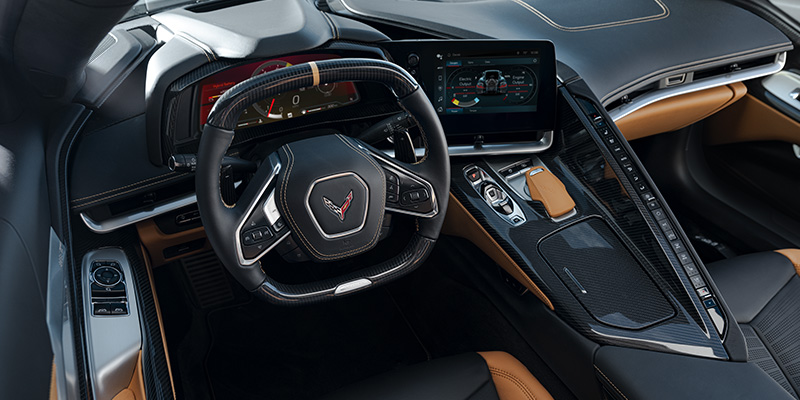
Understanding how electric assist integrates with launch control requires examining system architecture, torque distribution, battery placement, and traction management logic.
Core Powertrain Architecture
The E-Ray combines two propulsion systems:
Rear Axle:
- 6.2L LT2 naturally aspirated V8
- Mid-mounted configuration
- Eight-speed dual clutch transmission
Front Axle:
- Electric motor driving front wheels only
- Independent from rear drivetrain
- No mechanical driveshaft connecting front and rear
This layout creates an electronic all-wheel-drive system. Power is blended digitally rather than mechanically. The absence of a driveshaft reduces parasitic loss and allows instantaneous torque delivery to the front axle.
Combined output exceeds 650 horsepower. More important than peak horsepower is torque response timing.
Instant Electric Torque at Launch
Internal combustion engines generate peak torque at specific RPM ranges. Electric motors generate maximum torque immediately from zero RPM.
At launch, this difference is critical.
During launch control activation:
- The rear LT2 V8 builds revs within programmed parameters
- The front electric motor delivers immediate torque to the front wheels
- Torque vectoring optimizes grip across both front tires
This eliminates the brief delay associated with rear-wheel traction buildup in traditional rear-drive configurations.
Electric assist fills the torque curve at the moment traction is most limited.
Launch Control Sequence Explained
When launch control is engaged:
- Vehicle systems verify operating temperature and traction conditions.
- Stability control transitions into performance calibration mode.
- Rear engine RPM is staged within optimal torque band.
- Front motor preloads torque delivery.
- Upon brake release, both systems deploy synchronized power.
Because the front motor responds instantly, it stabilizes weight transfer and reduces wheelspin before the rear axle reaches peak torque output.
This coordination produces stronger initial bite and cleaner off-the-line acceleration.
eAWD and Torque Vectoring Benefits
Traditional AWD systems rely on mechanical differentials and driveshafts. The E-Ray uses electronic torque vectoring.
Key advantages:
- Instant front axle torque modulation
- Independent front left and right torque management
- No rotational inertia from mechanical coupling
- Rapid adaptation to changing traction surfaces
If one front wheel encounters reduced grip, the system can redirect torque in milliseconds.
This enhances launch stability on:
- Cold pavement
- Slightly damp surfaces
- Imperfect road textures
Consistency is one of the most overlooked aspects of high performance acceleration. The E-Ray’s hybrid architecture improves repeatability.
Battery Placement and Weight Distribution
The hybrid battery is positioned centrally within the chassis, between the seats along the center tunnel.
This location:
- Maintains low center of gravity
- Preserves front to rear balance
- Minimizes polar moment changes
Additional weight from electrification is strategically placed rather than concentrated over one axle.
The result is:
- Neutral corner entry
- Stable weight transfer during launch
- Improved traction distribution
Hybrid performance in the E-Ray is engineered for dynamic balance rather than solely power output.
Acceleration Metrics and Real-World Consistency
The E-Ray achieves 0 to 60 mph acceleration in under three seconds.
More significant than the headline number is how consistently it can reproduce that time.
Electric assist:
- Reduces rear tire slip
- Minimizes power interruption from traction control intervention
- Maintains optimal drivetrain loading
Repeated launch attempts generate less variation compared to purely rear-wheel-drive configurations.
For drivers evaluating measurable performance, this consistency reflects engineering intent.
Regenerative Braking Integration
The front electric motor also functions as a generator under deceleration.
Benefits include:
- Energy recapture during braking
- Enhanced brake balance stability
- Improved efficiency during normal driving
Regen braking does not compromise launch performance. Instead, it supports battery readiness for repeated torque assist deployment.
The system ensures adequate battery charge for performance bursts without requiring external charging.
Electric Assist Versus Traditional Traction Control
In a rear-drive sports car, traction control often reduces engine power to prevent wheelspin.
In the E-Ray:
- Traction management adds controlled front torque rather than removing rear power
- Power is redistributed rather than limited
- Acceleration feels uninterrupted
This difference defines the character of hybrid performance. Instead of restricting output, the system enhances grip to fully utilize it.
Is the E-Ray Faster Than a Rear-Drive Corvette at Launch
Under ideal dry conditions, both vehicles can produce impressive acceleration.
Under variable traction:
- The E-Ray’s eAWD system provides measurable advantage
- Electric torque fills gaps in rear traction
- Weight transfer is more stable
The hybrid architecture does not change the LT2’s character. It amplifies its launch capability.
Engineering Intent Behind Electric Assist
The purpose of electric assist in the E-Ray is not efficiency first. It is torque strategy.
By pairing instantaneous electric torque with naturally aspirated V8 output, Chevrolet engineered:
- Enhanced launch traction
- Improved acceleration repeatability
- All-weather performance capability
- Balanced mid-engine weight distribution
The result is a Corvette that maintains traditional V8 identity while expanding performance envelope through electrification.
Electric assist in the 2026 Corvette E-Ray does not dilute the Corvette formula. It sharpens its launch capability with measurable engineering precision.
Connect with us
