

The Corvette E-Ray represents a fundamental expansion of what Corvette performance means. Rather than chasing higher peak horsepower or higher rev limits, the E-Ray focuses on how power is delivered to the pavement. Its hybrid all-wheel-drive system is not designed for fuel economy or electric cruising. It is engineered to maximize traction, sharpen response, and produce repeatable acceleration in conditions where rear-wheel-drive performance cars struggle.
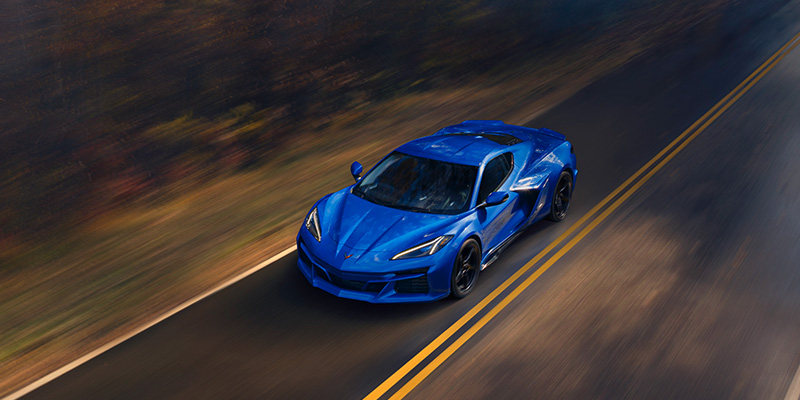
Understanding the E-Ray requires looking beyond combined horsepower figures and into how its hybrid and drivetrain systems interact in real driving.
Hybrid Architecture and System Layout
The E-Ray pairs a mid-mounted naturally aspirated V8 driving the rear wheels with a compact electric motor powering the front axle. There is no mechanical connection between the front and rear axles.
Key architectural elements include:
- Rear-mounted V8 driving the rear wheels through a dual-clutch transaxle
- Front-mounted electric motor powering the front wheels independently
- Battery system sized for power delivery, not range
- Electronic coordination replacing traditional AWD hardware
This layout allows instantaneous torque delivery to the front axle without the mass or delay of a driveshaft or transfer case.
Electric Front Motor and Torque Delivery
The electric motor’s primary role is torque fill and traction support. Unlike hybrid systems focused on efficiency, the E-Ray uses its electric motor to supplement acceleration and stabilize the chassis under load.
Performance benefits include:
- Immediate front axle torque at launch
- Reduced rear tire slip during hard acceleration
- Enhanced stability when exiting corners
- Improved responsiveness before the V8 reaches peak torque
This torque delivery smooths power application rather than overwhelming the rear tires, particularly on imperfect surfaces.
All-Wheel Drive Behavior and Control Strategy
The E-Ray’s AWD system is fully performance-oriented. It is designed to engage aggressively during acceleration and disengage seamlessly as conditions stabilize.
Key AWD characteristics include:
- Front motor engagement during launches and low-speed acceleration
- Dynamic torque modulation based on steering angle and throttle input
- Reduced understeer through controlled front axle assistance
- Predictable power delivery rather than constant AWD drag
At higher speeds, the system prioritizes rear-wheel drive behavior while maintaining the ability to intervene when traction demands it.
Acceleration and Launch Performance
One of the E-Ray’s defining traits is launch consistency. By combining rear-wheel power with front axle torque, the E-Ray can apply full system output without excessive wheelspin.
Real-world acceleration advantages include:
- Faster and more repeatable 0 to 60 launches
- Reduced reliance on traction control intervention
- Confidence-inspiring acceleration on cold or damp pavement
- Improved straight-line performance without excessive tire wear
This makes the E-Ray especially effective in street driving scenarios where surface conditions vary.
Weight Distribution and Chassis Impact
The addition of a front motor and battery does increase overall mass, but the placement of these components improves front axle engagement and balance.
Chassis effects include:
- More even longitudinal load distribution during acceleration
- Increased front-end authority during corner exit
- Greater stability during aggressive throttle application
- Reduced tendency toward rear-driven snap oversteer
Rather than dulling the driving experience, the added mass is used strategically to enhance control.
Track Behavior and Thermal Considerations
On track, the E-Ray behaves differently than rear-drive Corvettes. It rewards smooth inputs and benefits from its ability to deploy torque across both axles.
Track-relevant characteristics include:
- Strong corner exit traction in low-speed sections
- Reduced wheelspin when applying throttle early
- Consistent lap-to-lap acceleration behavior
- Thermal management designed to sustain electric assist under load
The system is not intended to replace a Z06 on a road course, but it provides a unique performance profile that emphasizes usable speed.
Street Usability and Real-World Performance
For street driving, the E-Ray’s hybrid system offers tangible advantages without changing the Corvette’s core character.
Drivers experience:
- Increased confidence in variable conditions
- Smooth, immediate throttle response
- Less need to modulate power manually
- Strong acceleration without constant electronic correction
This makes the E-Ray one of the most approachable high-performance Corvettes ever built.
E-Ray vs Traditional Performance Corvettes
Compared to rear-wheel-drive Corvettes, the E-Ray trades some ultimate track purity for traction and acceleration advantages.
The E-Ray is best suited for drivers who:
- Prioritize acceleration and drivability
- Drive aggressively on public roads
- Want maximum traction without sacrificing performance
- Value cutting-edge drivetrain technology
It fills a gap between traditional Corvette performance and modern hybrid supercar behavior.
Final Technical Perspective
The 2026 Corvette E-Ray is not a compromise and not an efficiency experiment. It is a performance-focused hybrid that uses electric torque to solve real traction and acceleration limitations inherent in rear-wheel-drive sports cars.
By combining a mid-engine V8 with an electric front axle, the E-Ray delivers a distinct performance experience centered on control, confidence, and repeatable speed rather than peak numbers alone.
Connect with us
