

The 2026 Corvette Stingray and E-Ray share the same mid-engine LT2 foundation, but they deliver power differently. One is a pure rear-wheel-drive expression of naturally aspirated V8 balance. The other adds an electric front axle, transforming traction strategy and launch consistency.
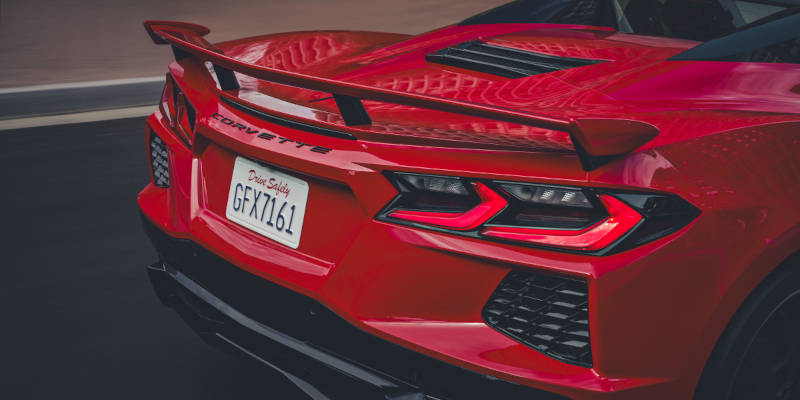
For buyers comparing these two Corvettes as real-world sports cars, the question is not simply which is faster. It is how drivetrain architecture affects daily drivability, traction confidence, ride behavior, and handling character.
Shared LT2 Foundation
Both Stingray and E-Ray use the 6.2L LT2 naturally aspirated V8 mounted behind the driver.
Common performance architecture:
- Mid-engine layout
- Eight-speed dual clutch transmission
- Lightweight aluminum structure
- Magnetic Ride Control availability
- Rear limited slip differential
This shared platform means cabin ergonomics, seating position, steering layout, and base suspension geometry are fundamentally similar.
Where they differ is how torque reaches the pavement.
Rear-Wheel Drive vs Electronic All-Wheel Drive
Stingray:
- Rear-wheel drive only
- Power delivered exclusively to rear axle
- Mechanical traction management
E-Ray:
- Rear LT2 V8
- Independent front electric motor
- Electronic all-wheel drive system
- No mechanical driveshaft between axles
The E-Ray’s front motor activates automatically based on traction demand and acceleration input. Torque is distributed electronically rather than mechanically.
In dry conditions, both vehicles offer strong grip. In low traction scenarios such as damp pavement, the E-Ray deploys additional front axle torque to stabilize acceleration.
0 to 60 Acceleration and Launch Behavior
Stingray delivers rapid acceleration through optimized rear traction and launch control calibration.
E-Ray enhances launch through:
- Instant electric torque at the front axle
- Reduced rear wheelspin
- Improved weight transfer stability
The electric motor provides immediate torque from zero RPM, eliminating lag during initial acceleration.
As a result, E-Ray achieves quicker and more consistent 0 to 60 times, particularly in non-ideal surface conditions.
For drivers who prioritize maximum launch performance regardless of weather, the hybrid system offers measurable advantage.
Handling Character and Weight Considerations
The E-Ray carries additional weight due to:
- Front electric motor
- High voltage battery system
- Cooling components
Battery placement is centralized within the chassis to preserve balance.
Handling Differences:
Stingray:
- Slightly lighter overall weight
- Pure rear-drive rotation feel
- More traditional sports car weight transfer dynamics
E-Ray:
- Increased front axle engagement
- Enhanced stability under throttle
- More planted acceleration out of corners
The Stingray emphasizes mechanical purity and rear-drive responsiveness.
The E-Ray prioritizes traction authority and stability.
Drivers who enjoy throttle steering and rear bias dynamics may gravitate toward Stingray. Drivers seeking controlled power deployment in varied conditions may prefer E-Ray.
Ride Comfort and Suspension Behavior
Both models offer available Magnetic Ride Control.
This system continuously adjusts damper stiffness based on:
- Road surface conditions
- Steering input
- Acceleration forces
Daily ride comfort differences between Stingray and E-Ray are minimal under similar suspension configurations.
The E-Ray’s additional front axle mass slightly alters front-end feedback, but suspension tuning compensates for added weight.
For commuting and long-distance driving, cabin comfort and seat support remain consistent across both variants.
Wet Weather and All-Season Driving
One of the most significant daily driving differences appears in wet or cooler climates.
Stingray:
- Relies on rear tire traction
- Requires more deliberate throttle control in reduced grip
E-Ray:
- Deploys front torque to stabilize acceleration
- Reduces rear slip under throttle
- Improves traction exiting intersections or merging in rain
Electronic all-wheel drive provides additional confidence when road conditions are inconsistent.
For drivers in areas with frequent rain or seasonal temperature changes, this difference may influence decision-making more than raw performance numbers.
Regenerative Braking Feel
The E-Ray incorporates regenerative braking via the front motor.
Under deceleration:
- Front motor recaptures energy
- Brake blending integrates mechanical and regenerative braking
Chevrolet calibrates this system to maintain natural brake pedal feel. Drivers transitioning from Stingray to E-Ray may notice subtle differences in low-speed deceleration response, but braking remains linear and predictable.
Fuel Economy Considerations
Hybrid assistance can improve efficiency during certain driving scenarios.
However, both vehicles are performance-oriented.
Fuel economy differences exist but are not the primary purchasing driver for this segment.
The E-Ray’s hybrid system is engineered for performance enhancement first and efficiency second.
Which Corvette Is Better for Daily Driving?
Choose Stingray if:
- You prefer traditional rear-wheel-drive dynamics
- You value lighter weight and mechanical purity
- You drive primarily in dry conditions
- You prioritize simplicity in drivetrain architecture
Choose E-Ray if:
- You want all-wheel-drive traction
- You drive in varied weather conditions
- You prioritize launch consistency
- You value hybrid torque fill for immediate acceleration
Both Corvettes deliver high-performance capability rooted in the same LT2 engine architecture.
The Stingray maintains classic rear-drive engagement. The E-Ray expands usability by integrating electronic front torque and hybrid assistance.
For daily driving, the choice depends on whether you prioritize traditional sports car dynamics or traction-enhanced performance versatility.
Connect with us
