

The LT2 vs LT6 Corvette engine discussion starts long before horsepower numbers enter the conversation, because these two V8 layouts change how the car sounds, reacts, shifts, and communicates with the driver. Buyers researching the Corvette Stingray and Corvette Z06 usually begin with output figures, quarter mile times, or trim comparisons, but the larger distinction comes from engine architecture itself. Chevrolet engineered these powerplants with completely different personalities in mind. One delivers immediate torque with a deep, muscular cadence. The other builds intensity through rev speed, airflow, and razor-sharp response. Understanding how those traits appear behind the wheel creates a much clearer picture of which Corvette belongs in your garage.
Why LT2 and LT6 Feel Different Before Full Throttle
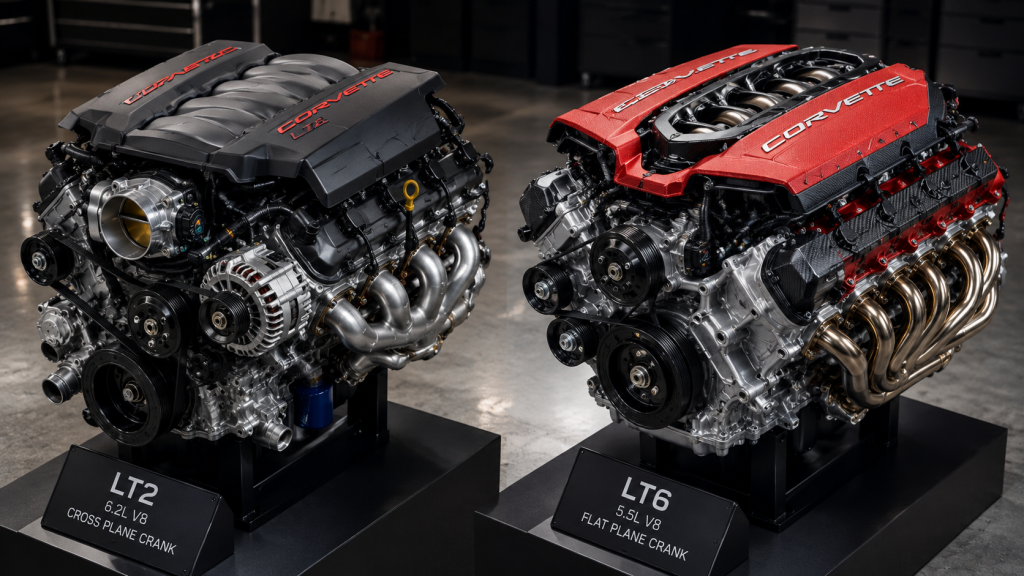
The LT2 in the Corvette Stingray uses a traditional cross plane crankshaft pushrod V8 layout. That configuration creates a smoother idle character, stronger low RPM torque delivery, and a heavier exhaust pulse rhythm. Even before aggressive acceleration, the Stingray feels settled and substantial. Small throttle inputs create immediate forward movement because torque arrives earlier in the rev range.
The LT6 in the Corvette Z06 approaches engine response very differently. Chevrolet developed this naturally aspirated 5.5 liter V8 around rapid airflow movement and high RPM breathing. Instead of emphasizing low-speed shove, the LT6 builds urgency through rev speed and throttle sharpness. Press the accelerator lightly in a Z06 and the engine climbs through RPM far faster than the Stingray. Drivers notice that change immediately during merges, lane changes, and corner exits.
That difference alters how the dual clutch transmission behaves as well. The Stingray transmission tuning keeps shifts calm and relaxed during casual driving. Gear changes happen lower in the RPM range because the LT2 produces strong usable torque without needing aggressive downshifts.
The Z06 behaves differently because the LT6 wants to remain active higher in the rev range.
Drivers may notice:
- More frequent downshifts during acceleration
- Sharper throttle sensitivity during partial pedal inputs
- Faster RPM climbing between shifts
- Greater engine sound presence during normal driving
Those differences create two distinct personalities before either car approaches maximum acceleration.
What Is a Flat Plane Crank and Why Does It Matter?
A flat plane crankshaft changes the firing sequence and rotational balance inside the engine. In the LT6, crankshaft journals sit 180 degrees apart instead of the cross shaped layout used in the LT2. That design changes airflow rhythm, vibration character, and exhaust pulse timing.
The result is an engine that revs more freely and responds more quickly to throttle movement. Rotating mass inside the LT6 changes direction with less inertia, allowing RPM to climb rapidly. That sharper response becomes one of the defining traits of the Corvette Z06.
The tradeoff appears in engine smoothness. Cross plane crank V8 engines like the LT2 naturally balance vibrations more effectively, producing the deeper rumble associated with traditional American V8 sound. Flat plane crank engines create a higher frequency exhaust note with more mechanical sharpness because firing pulses alternate differently between cylinder banks.
That architecture also changes breathing efficiency at higher RPM. The LT6 uses dual overhead camshaft valvetrain engineering to support airflow stability as engine speed climbs toward its extremely high redline. The LT2 pushrod layout prioritizes compact packaging and strong torque delivery lower in the powerband.
Competitor articles usually stop at “flat plane crank equals exotic sound,” but the larger mechanical story involves airflow timing, crankshaft inertia, and combustion rhythm.
From the driver seat, that translates into:
- Faster rev transitions
- More urgent acceleration feel
- Higher pitch exhaust tone
- Increased sensitivity during throttle modulation
- More active engine personality during spirited driving
Street Driving and Highway Cruising Reveal Different Priorities
The Corvette Stingray and Corvette Z06 separate themselves most clearly during ordinary driving situations. Highway cruising, stoplight acceleration, parking lot maneuvering, and suburban commuting expose how differently these engines interact with daily traffic rhythm.
The LT2 settles into lower RPM cruising naturally. Its torque curve supports relaxed acceleration without requiring aggressive pedal movement. During highway passing situations, the Stingray can accelerate strongly without dramatic transmission downshifts or elevated engine noise. That creates a calmer grand touring personality.
The LT6 introduces more sensory intensity into every interaction. Because power builds progressively through RPM, the engine remains more active during acceleration events. Drivers hear intake sound, exhaust sharpness, and valvetrain activity more prominently throughout the rev range.
This does not make the Z06 difficult to drive. Instead, it creates a more engaged relationship between driver inputs and engine reaction.
Buyers considering daily ownership should evaluate:
- Desired exhaust volume during commuting
- Preference for low RPM torque versus high RPM excitement
- Interest in track-focused response tuning
- Sensitivity to sharper throttle calibration
- Highway cruising priorities
Some drivers immediately connect with the Z06 because every acceleration event feels dramatic and urgent. Others prefer the Stingray because it balances speed with calmer drivability.
Why the LT6 Sounds Completely Different
The sound distinction between these Corvettes originates directly from firing order rhythm and airflow behavior. Cross plane crank V8 engines create overlapping exhaust pulses that produce the traditional deep American V8 rumble. The LT2 delivers that familiar cadence with strong low-frequency resonance and slower exhaust rhythm.
The LT6 changes that acoustic structure entirely. Flat plane crank timing spaces exhaust pulses more evenly, producing a sharper, smoother, higher-frequency sound profile. As RPM climbs, the engine develops a layered mechanical tone closer to endurance racing engines than traditional pushrod V8 muscle cars.
Air intake tuning contributes heavily as well. Chevrolet engineered the LT6 intake path to support sustained high RPM airflow stability. Drivers hear that airflow movement increase dramatically as revs climb, adding to the engine’s exotic character.
The emotional distinction becomes substantial during acceleration:
- LT2 delivers heavier bass-driven acceleration sound
- LT6 produces sharper rising pitch intensity
- Stingray emphasizes torque sensation
- Z06 emphasizes RPM escalation and urgency
That difference shapes emotional connection more than raw output numbers for many buyers.
Choosing Corvette Character Instead of Chasing Numbers
The LT2 vs LT6 Corvette engine debate becomes easier once buyers stop viewing the decision as “base versus upgraded.” These engines pursue entirely different emotional goals.
The Corvette Stingray focuses on broad accessibility, deep torque delivery, and balanced drivability. Its pushrod V8 creates a familiar American sports car rhythm with enough refinement to feel composed during long highway drives or daily commuting.
The Corvette Z06 introduces a far more intense relationship between engine speed and driver input. The flat plane crank LT6 transforms the car into something sharper, louder, and more reactive. It rewards aggressive throttle application and high RPM driving in ways the Stingray intentionally does not pursue.
Neither setup replaces the other.
Instead, Chevrolet engineered two separate interpretations of Corvette character:
- One centered around muscular torque and composure
- One centered around rev speed, sharpness, and sensory drama
Drivers choosing between them should focus less on horsepower hierarchy and more on which engine personality matches the kind of driving they want to remember after the road straightens out.
Connect with us
