

Performance in the C8 Corvette is not defined by peak output alone. It is defined by how consistently that performance can be delivered under sustained load. Many shoppers researching Corvette engineering ask how the cooling system actually works and why it becomes more complex in higher-performance models. The answer is that thermal management is not a single component. It is a coordinated system designed to control heat across the engine, transmission, brakes, and, in the case of the E-Ray, hybrid components.
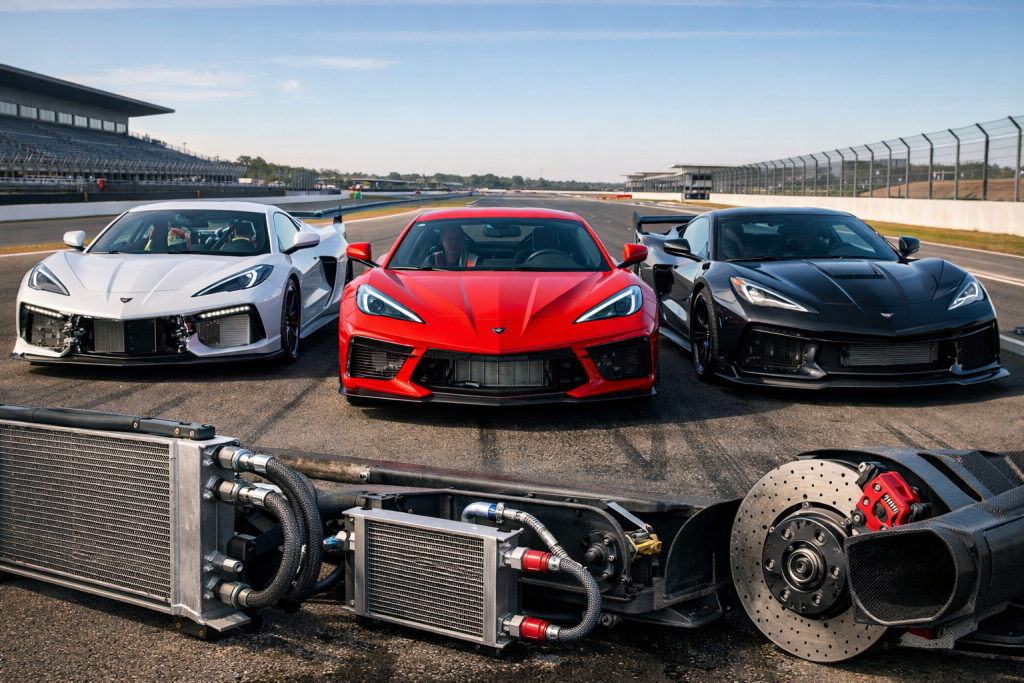
Thermal management is the system a performance car uses to regulate temperature across all major mechanical and electronic systems so they can operate within optimal ranges. In the 2026 Corvette Stingray, 2026 Corvette Z06, and 2026 Corvette E-Ray, that system is engineered differently because each model generates heat in different ways and at different intensities.
How the Corvette Cooling System Works as a Complete Network
The Corvette cooling system operates as a distributed thermal network rather than relying on a single radiator. Many drivers ask how the Corvette cooling system works under aggressive driving, and the key is that multiple subsystems are working at the same time to move heat away from critical components.
The Corvette cooling system includes front-mounted radiators, auxiliary heat exchangers, coolant circuits, and airflow channels that are all coordinated to manage temperature across the vehicle. Engine coolant absorbs heat from the combustion process and transfers it to the Corvette radiators, where passing air removes that heat. At the same time, separate fluid systems regulate oil and transmission temperatures through dedicated heat exchangers.
Airflow plays a central role in this process. The Corvette airflow system directs air through front intakes, across cooling cores, and out through vents that extract heat from the engine bay and underbody. This continuous movement of air ensures that heat does not accumulate in one area, which is critical during sustained high-load driving.
Because the Corvette cooling system operates as a network, it can manage multiple heat sources simultaneously rather than reacting to a single temperature spike. This allows the vehicle to maintain stable operating conditions even when engine load, braking demand, and drivetrain stress are all elevated at the same time.
Why Heat Management Directly Impacts Performance
Many shoppers assume cooling is only about preventing overheating, but heat management directly affects how the Corvette performs moment to moment. Why do performance cars need more advanced cooling systems? Because heat changes how mechanical and electronic systems behave long before a failure occurs.
As temperatures rise within the Corvette engine and supporting systems, several performance changes begin to occur. Intake air becomes less dense as it heats up, which reduces combustion efficiency and limits power output. Engine oil and transmission fluid are also affected by temperature. As fluid temperatures increase, viscosity decreases, which reduces the ability of those fluids to lubricate and protect internal components under load.
Brake performance is also directly tied to heat. During repeated high-speed braking, friction between the brake pads and rotors generates significant thermal energy. If that heat is not removed efficiently, brake fade can occur, reducing stopping power and consistency.
Electronic systems within the Corvette also monitor temperature closely. If heat levels exceed calibrated thresholds, the vehicle may reduce power output or adjust system behavior to protect components. This is not a failure condition. It is a protective response that prevents long-term damage but also highlights why effective cooling is critical for maintaining consistent performance.
How Airflow and Heat Exchangers Work Together
Airflow in the Corvette is not only about aerodynamics. It is a primary tool for thermal control. Many drivers see vents, ducts, and openings as styling elements, but in the Corvette airflow system, these features are engineered to manage heat.
Air enters through the front of the Corvette and is directed toward radiators and heat exchangers. A heat exchanger is a component that transfers heat from a fluid system into passing air so temperatures remain within an effective operating range. Once air passes through these components, it carries heat away from the vehicle.
The Corvette airflow system also directs air toward the braking system. Brake cooling ducts channel air toward the rotors, allowing heat to dissipate more quickly during repeated braking events. Without this airflow, brake temperatures would rise rapidly, reducing effectiveness.
After absorbing heat, air must be removed efficiently. The Corvette uses vents and underbody pathways to extract hot air from the engine bay and surrounding areas. This prevents heat from becoming trapped, which would reduce the effectiveness of the entire cooling system.
Because airflow is controlled from entry to exit, the Corvette cooling system maintains a continuous cycle of heat removal that supports both engine performance and overall vehicle stability.
Why Stingray, Z06, and E-Ray Require Different Cooling Strategies
Each Corvette model produces heat in a different way, which is why each uses a distinct thermal management approach.
The 2026 Corvette Stingray cooling system is designed for balanced performance. Its naturally aspirated V8 produces strong power without the sustained thermal load of track-focused driving. The Stingray cooling system focuses on maintaining stable temperatures across a wide range of conditions, making it well-suited for daily driving and occasional high-performance use.
The 2026 Corvette Z06 heat management system is engineered for continuous high-load operation. Its high-revving engine generates more sustained heat, especially during track driving where engine speed and load remain elevated. To support this, the Corvette Z06 cooling system uses increased airflow capacity, larger cooling components, and more aggressive heat extraction strategies. This allows the Z06 to maintain consistent performance across repeated laps rather than experiencing performance drop-off.
The 2026 Corvette E-Ray thermal management system introduces additional complexity because it must manage both combustion and electrified systems. In addition to engine heat, the Corvette E-Ray must regulate temperature for its battery and front electric motor. This requires separate cooling circuits for hybrid components, ensuring that electrical systems operate within safe temperature ranges without affecting engine cooling performance.
These differences are not just technical. They reflect the intended use of each model. The Stingray is engineered for versatility, the Z06 for track performance, and the E-Ray for combining performance with hybrid capability.
How Corvette Cooling Supports Track Consistency Over Time
Track driving creates a sustained thermal environment that is very different from normal driving. Engine load remains high, braking is repeated, and airflow conditions change constantly. In this environment, the Corvette cooling system must manage heat continuously rather than allowing temperatures to recover between events.
The Corvette cooling system supports track consistency by stabilizing temperatures across multiple systems at once. Engine cooling maintains consistent combustion conditions, allowing the Corvette to deliver predictable power output. Brake cooling ducts ensure that braking performance remains stable even after repeated high-speed stops. Transmission cooling helps maintain smooth and reliable gear changes under aggressive driving.
This coordinated approach prevents performance degradation over time. Instead of delivering peak performance for a short burst, the Corvette is engineered to sustain performance across an entire session.
For drivers, this translates into confidence. The vehicle responds the same way on later laps as it does on the first, which is a direct result of how effectively the Corvette cooling system manages heat.
What This Means for Corvette Buyers
Understanding the Corvette cooling system helps explain how each model performs in real-world conditions and how to choose the right configuration.
Buyers comparing the Corvette Stingray, Corvette Z06, and Corvette E-Ray should evaluate how they plan to use the vehicle and how thermal management supports that use.
• The Corvette Stingray cooling system is designed for drivers who want strong, reliable performance in everyday conditions with the ability to handle occasional high-load driving
• The Corvette Z06 heat management system is built for drivers who plan to push the vehicle consistently, particularly in track environments where sustained performance matters
• The Corvette E-Ray thermal management system supports drivers who want advanced performance with hybrid capability, balancing power delivery with additional system complexity
Cooling is not a background feature. It is a defining part of how each Corvette delivers performance, consistency, and confidence. By managing heat effectively, the Corvette ensures that power, braking, and handling remain stable, allowing drivers to focus on how the car responds rather than how it recovers.
Connect with us
