
Track cooling matters when repeated Corvette braking pushes heat from the rotors and calipers toward the brake fluid. In addition, every hard stop on a road course converts speed into heat at the friction surfaces. Short recovery periods can also keep temperatures elevated from one braking zone to the next. That heat can travel through the calipers and into the hydraulic fluid. Therefore, track preparation should include fluid grade, boiling points, fluid age, and Chevrolet guidance.
Why Track Braking Raises Brake Fluid Temperature
Brake pads clamp the rotors and turn vehicle motion into heat. Therefore, the rotors absorb much of that heat first. However, the calipers sit directly beside those hot friction surfaces. As a result, heat can move through the caliper body toward the brake fluid inside.
Why can brake fluid become a problem during a track session? Brake fluid must stay liquid so pedal force transfers through the hydraulic circuit. Once fluid reaches its boiling threshold, vapor can form. Because vapor compresses more easily than liquid, pedal travel can increase.
Track cooling works alongside brake hardware by managing the heat that reaches each part. Airflow around the brakes can remove heat between braking zones. Still, repeated high energy stops can outpace that heat removal. For this reason, fluid needs enough thermal margin for the session.
Z06 and Z07 hardware can manage intense brake heat, but fluid preparation still matters. Z07 carbon ceramic discs resist high rotor temperatures very well. Nevertheless, brake fluid still sits inside the calipers. Strong rotor hardware does not remove the need for fresh, qualified fluid.
Dry and Wet Boiling Points Explained
Dry boiling point measures fresh brake fluid with very little moisture present. Wet boiling point measures fluid after controlled moisture contact. Therefore, the second number is lower because absorbed water reduces the temperature required for boiling.
Which boiling point matters more before a track day? Both matter, because one describes fresh fluid and the other reflects moisture contact. A high dry number gives fresh fluid more thermal margin. The wet number shows how far that margin can fall after moisture enters the fluid.
Federal minimums show the difference clearly. DOT 3 starts at a minimum of 401°F dry and 284°F wet. DOT 4 starts at 446°F dry and 311°F wet. DOT 5.1 starts at 500°F dry and 356°F wet.
However, those values are minimum standards, not the exact numbers for every product. A track focused DOT 4 fluid can exceed the minimum by a wide margin. Chevrolet specifies qualified DOT 4 with a dry boiling point above 590°F for current Corvette track preparation. Therefore, the product data matters more than the grade number alone.
Track cooling decisions should also account for fluid age. In addition, fresh fluid starts closer to its published dry rating. Consequently, moisture lowers that thermal margin. As a result, an older fluid can reach vapor formation sooner during repeated braking.
Does DOT 5.1 Beat DOT 4 for Track Driving?
DOT classifications establish minimum test thresholds for brake fluid. They do not rank every product from weak to strong. A specific DOT 4 fluid can carry a higher boiling point than a basic DOT 5.1 fluid.
Does DOT 5.1 automatically make a stronger Corvette track choice? No, because Chevrolet specifies qualified DOT 4 for current track preparation. That instruction should guide fluid selection before generic grade comparisons. In addition, owners should verify the exact product boiling points and Corvette track instructions.
The three grades differ in their federal minimum boiling thresholds:
- DOT 3 has the lowest minimum dry and wet thresholds of the three grades discussed here.
- DOT 4 raises both minimum thresholds and includes track fluids that exceed the basic federal floor.
- DOT 5.1 raises the federal minimums again, but Chevrolet still calls for qualified DOT 4 for Corvette track preparation.
Do not confuse DOT 5.1 with DOT 5 silicone fluid. In addition, they are different fluid classes. Chevrolet specifically says not to use DOT 5 silicone brake fluid for track preparation. Therefore, the decimal in DOT 5.1 matters when reading a bottle or service document.
How Boiling Fluid Creates a Soft Pedal
The hydraulic circuit relies on liquid brake fluid to carry force from the pedal toward the calipers. Therefore, liquid resists compression under normal brake pressure. By contrast, vapor does not.
Why can the pedal soften after several hard laps? Vapor formation creates compressible pockets inside the hydraulic circuit. More pedal movement then goes into compressing that vapor. Consequently, less of the initial pedal movement reaches the caliper pistons as direct hydraulic force.
The driver may feel longer pedal travel or a softer response. In severe cases, stopping force can fall enough to end the session. However, that sensation differs from simple pad wear because the change can appear quickly as brake temperatures rise.
Track cooling reduces heat around the brake assembly, yet fluid selection provides another layer of thermal margin. The two work together. Track cooling also preserves thermal margin by limiting heat transfer toward the calipers. Cooling controls how much heat reaches the caliper area. High boiling fluid raises the temperature required before vapor can form.
If the pedal changes during a session, the safest response is to stop track driving and inspect the brake setup. Continued hard laps can add more heat. A service check can evaluate fluid, pads, rotors, calipers, and related brake parts.
How Fluid Age Changes Track Preparation
Brake fluid can absorb moisture while it remains in the hydraulic circuit. That moisture lowers the boiling threshold. Therefore, mileage alone does not show how much thermal margin remains.
Does low mileage mean the fluid is ready for a track day? No, because time and moisture matter alongside mileage. Chevrolet gives Corvette owners a much shorter fluid age window for competitive driving. Current track guidance says to replace qualified fluid when its age exceeds one month or is unknown.
In addition, Chevrolet calls for fluid from a sealed container. That instruction protects the starting state of the fluid before it enters the car. An opened container can absorb moisture from the air. Therefore, track preparation should begin with known fluid age and known container history.
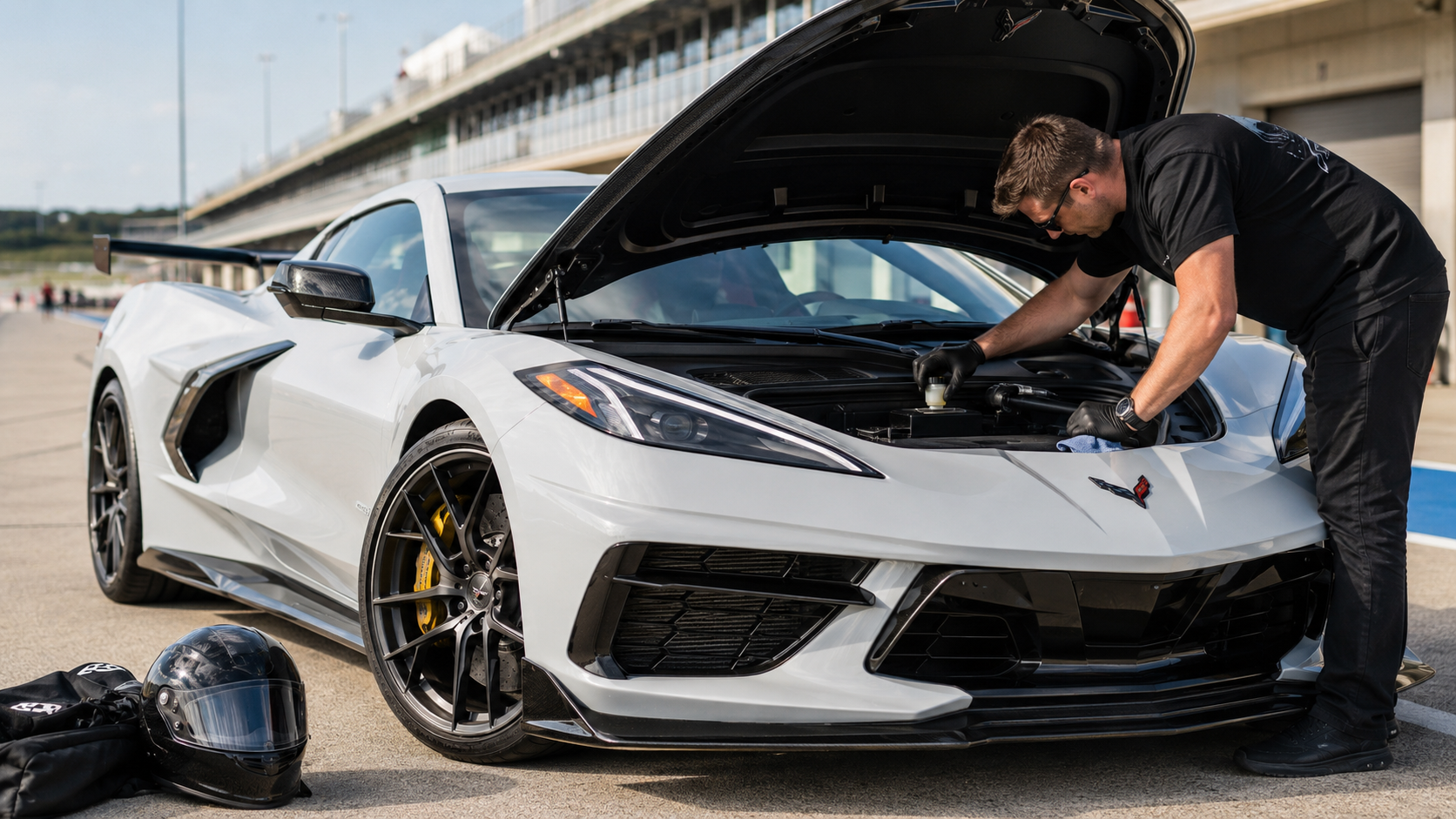
Track cooling planning should treat freshness as part of the brake setup. Owners should verify fluid level before the event as well. A fresh, correctly filled brake circuit gives the car a stronger thermal starting point before repeated hard stops.
Choosing Brake Fluid for a Z06 or Z07 Track Day
Corvette track preparation should start with Chevrolet instructions for the exact model and model year. Then, compare the fluid specification against those instructions. For current track guidance, qualified DOT 4 above 590°F dry is the key requirement.
Before choosing fluid, review these items:
- Confirm the fluid meets the Chevrolet track specification for the exact Corvette and model year.
- Check both dry and wet boiling points instead of relying on the DOT grade alone.
- Verify fluid age, container history, fluid level, and the rest of the brake setup before driving on track.
A Z06 or Z07 owner should also review pads, rotors, calipers, cooling hardware, and tire setup before a track event. Brake fluid works inside that larger thermal chain. Therefore, one strong fluid number cannot replace complete preparation.
Track cooling and brake fluid preparation belong in the same conversation because both address heat. One manages how quickly brake parts shed heat. The other sets the thermal margin inside the hydraulic circuit. For Corvette owners heading to a road course, both deserve attention before the first session.