Ross Downing Corvettes

Blog

6 Performance Highlights of the 2025 Corvette Stingray

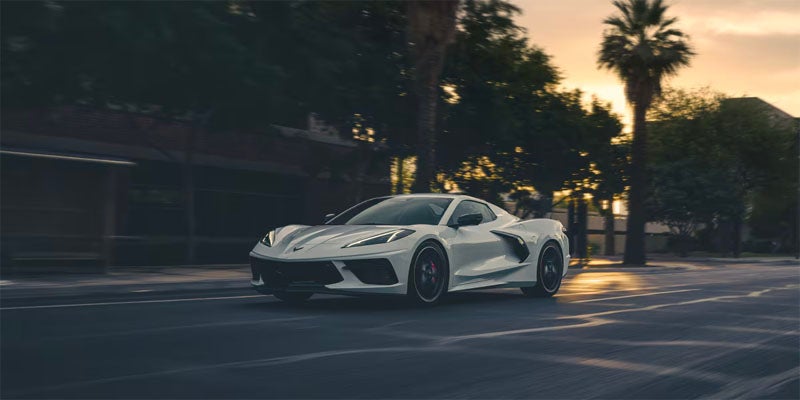
silver corvette

Engineered to tear up streets and embarrass supercars, the 2025 Corvette Stingray represents the pinnacle of American performance. Its highlights include a naturally aspirated V8, an aerodynamic design, and a driver-focused cockpit.

6 Performance Highlights of the 2025 Corvette Stingray

Naturally Aspirated V8

Although the Corvette Stingray is the entry point to Chevrolet's sports car lineup, its powertrain is anything but basic. The Stingray is powered by a naturally aspirated 6.2L V8 that generates a thunderous 490 hp and 465 lb-ft of torque. Improving both efficiency and performance, the engine features variable valve timing, active fuel management, and a dry-sump oil system. Pairing the engine with the available performance exhaust (included in the Z51 Performance Package) bumps up the output to 495 hp and 470 lb-ft of torque. This is enough power to catapult the Stingray from 0 to 60 mph in 2.9 seconds.

Dual-Clutch Transmission

Another performance highlight of the Corvette Stingray is its 8-speed dual-clutch transmission, which manages the naturally aspirated V8 power. It provides ultra-fast gear changes that only take a hundred milliseconds to happen. Drivers can upshift, downshift, and disengage the clutch using the steering-wheel-mounted paddle shifters.

Mid-Engine Layout

The naturally aspirated V8 is positioned behind the driver and in front of the rear axle rather than under the hood. This mid-engine layout gives the Stingray nearly 50-50 weight distribution and a low center of gravity. As a result, the sports car is more stable, enjoys better traction, and handles more smoothly than its rivals.

Track-Oriented Suspension

A cutting-edge SLA suspension with 46 mm monotube shock absorbers and a direct-acting stabilizer bar underpins the Corvette Stingray. It provides outstanding lateral stiffness and reduced body roll, allowing the sports car to corner aggressively while keeping its wheels planted. Buyers can upgrade to the Z51 Performance suspension with Magnetic Selective Ride Control for even better maneuverability. This innovative setup uses a magnetorheological fluid to provide precise adaptive damping and more consistent performance across different driving conditions.

Aerodynamic Design

The Corvette Stingray's aerodynamic design enables it to reach a blistering top speed of 194 mph. The sports car features a low profile, a chiseled body, large front air intakes, and signature side air intakes, all of which either reduce drag or redirect air to cool the V8 engine. The Stingray also features a high rake angle, thanks to its 19-inch front and 20-inch rear wheels.

Driver-Focused Cockpit

Stepping inside the sports car, you will find yourself seated in a driver-focused cockpit with minimal clutter. Important vehicle information is displayed on the 12-inch reconfigurable digital instrument display, while the 8-inch center display angled towards the driver provides infotainment. With the available head-up display, driving information, such as speed, tach, and gear, can also be projected directly onto the windshield.

Take the Corvette Stingray out for a spin to experience its unapologetic performance firsthand. Reach out to us at Ross Downing Corvettes in Hammond, LA to schedule a test drive.

Recommended Posts

Corvette Engines and Powertrains for 2026 Compared

Corvette engines for 2026 include three gasoline V8 designs spread across five distinct drivetrain configurations. Stingray, E Ray, Z06, ZR1, and ZR1X each deliver power through a different mechanical path. Therefore, choosing among them requires more than comparing peak horsepower. The LT2 serves Stingray and E Ray. The LT6 powers Z06, while the LT7 powers ZR1 and ZR1X. In addition, E Ray and ZR1X add front axle electric drive. That addition changes traction and total output without replacing the V8 behind the cabin. Stingray and the LT2 V8 What makes the Stingray LT2 distinct? Its 6.2 liter displacement and cross plane crankshaft support strong torque across common road speeds. In addition, Chevrolet rates the engine at 490 horsepower and 465 pound feet of torque. The available exhaust raises those figures to 495 horsepower and 470 pound feet. Moreover, the LT2 uses overhead valves within a compact small block layout. Therefore, the engine fits tightly behind the passenger compartment. Its larger displacement also produces a broad torque curve without requiring extreme engine speed. more A cross plane crankshaft places its crank pins at 90 degree intervals. Consequently, the firing rhythm creates the deep V8 sound linked with Stingray. The layout also adds counterweights that reduce vibration during road travel. The LT2 reaches useful torque at lower engine speeds. Therefore, drivers do not need to chase the redline for quick response. The eight speed dual clutch transmission keeps the engine near the needed range. As a result, Stingray delivers direct acceleration during passing, highway entry, and winding road travel. How E Ray Expands the LT2 Does E Ray replace the LT2 with a hybrid engine? No. E Ray keeps the 495 horsepower LT2 at the rear. It then adds a 160 horsepower electric motor at the front axle. Together, both sources produce 655 horsepower. In addition, this output reaches the road through two separate axles. However, the two axles receive power from separate units. The V8 drives the rear wheels through the dual clutch transmission. The electric motor sends torque directly to the front wheels. This layout creates electrified all wheel drive. Moreover, electric torque arrives quickly when the driver presses the accelerator. That front axle force can support a stronger launch before the rear tires carry the full task. The battery sits within the central tunnel between the seats. Therefore, E Ray does not need a charging plug. Braking and normal driving replenish the battery for later electric assistance. E Ray gives the LT2 a new role without changing its basic character. The V8 still supplies most of the output and sound. In addition, the front motor adds traction and low speed response. Z06 and the LT6 Flat Plane V8 Why does the Z06 engine rev higher than the LT2? The LT6 uses a flat plane crankshaft and dual overhead camshafts. Moreover, Chevrolet rates the 5.5 liter V8 at 670 horsepower with an 8,600 rpm redline. A flat plane crankshaft arranges its crank pins at 180 degree intervals. This design reduces rotating mass and supports quicker changes in engine speed. In addition, the exhaust pulses follow a different rhythm than those from the LT2. Dual overhead camshafts place the camshafts above the cylinder heads. They control four valves per cylinder and support high airflow at elevated rpm. Therefore, the LT6 can keep building power near its redline. The LT6 draws air without turbochargers. Throttle movement changes airflow directly through the intake path. Consequently, the engine responds with a sharp rise in speed and a high pitched exhaust note. Z06 pairs this engine with wider bodywork, larger cooling paths, and track focused hardware. Still, the engine remains the center of its identity. Drivers who value high rpm response and natural aspiration will notice the LT6 most. ZR1 and ZR1X With the LT7 Does ZR1X use a different V8 than ZR1? No. Both models use the twin turbocharged 5.5 liter LT7. Chevrolet rates that engine at 1,064 horsepower and 828 pound feet of torque. The LT7 shares its basic bore spacing and flat plane layout with the LT6. However, Chevrolet revised major internal parts for turbocharged operation. Two turbochargers force more air into the cylinders, which permits much greater fuel flow and output. By contrast, ZR1 sends LT7 power to the rear wheels. Therefore, tire grip and electronic torque control shape the opening phase of acceleration. Once speed rises, the engine continues pulling through the dual clutch transmission. ZR1X adds a 186 horsepower front axle motor. Combined output reaches 1,250 horsepower through electrified all wheel drive. The electric unit adds front wheel torque while the LT7 drives the rear axle. The difference between these two models comes from power distribution: ZR1 uses the LT7 and rear wheel drive. ZR1X uses the LT7 plus a front electric motor. ZR1X combines gasoline and electric output across both axles. Thus, the LT7 remains the gasoline heart of both cars. The ZR1X electric unit adds traction and total output without creating a fourth V8. Which 2026 Corvette Powertrain Fits Your Driving? Which Corvette powertrain fits your plans? Start with the sound, engine response, traction layout, and roads you expect to drive. Peak horsepower matters, but the way each model delivers force matters too. First, Stingray offers the LT2 in its simplest form. Its broad torque and familiar V8 rhythm suit drivers who want strong road manners with room for track visits. E Ray keeps that LT2 sound while adding front axle electric force. Therefore, it suits drivers who value all wheel drive traction and quick low speed response. By contrast, Z06 takes a different path. Its LT6 rewards engine speed, sharp response, and a distinctive flat plane sound. As a result, it speaks most clearly to drivers drawn toward high rpm track work. ZR1 uses turbocharging to push the LT7 far beyond the naturally aspirated engines. ZR1X adds front electric drive for greater total output and traction across both axles. Before choosing, compare these points: Decide whether you prefer cross plane depth or flat plane pitch. Consider rear wheel drive or electrified all wheel drive. Compare natural aspiration with twin turbocharged power. Match the car with your road and track plans. The 2026 Corvette lineup gives each V8 a clear purpose. Therefore, the strongest choice is the one whose power delivery matches your own driving plans.

What Year Did Corvette Go to Mid Engine and What Changed

What year did Corvette go to mid engine? The change arrived with the 2020 Corvette Stingray, revealed in July 2019. Both dates appear in Corvette history because they mark different points. Chevrolet showed the C8 during 2019, then released it for the 2020 model year. That answer gives you the date, but the engineering story reaches much farther back. Chevrolet had studied rearward engine placement for decades. Therefore, the C8 was not a sudden rejection of Corvette history. It brought a long running idea into regular production. When Corvette Became Mid Engine The C7 closed Corvette’s front engine production chapter after the 2019 model year. Then, Chevrolet introduced the eighth generation Stingray with its V8 behind the passenger compartment. Therefore, the new car carried a 2020 model year designation. Why do some sources say 2019 while others say 2020? Chevrolet unveiled the car on July 18, 2019. However, dealerships received it as a 2020 Corvette Stingray. Thus, 2019 marks the public reveal, while 2020 identifies the first production model year. more Generation names also make the timeline easier to follow. C7 refers to the seventh generation, which kept its engine ahead of the cabin. C8 identifies the eighth generation and its new engine position. Furthermore, the change reshaped the car’s proportions. The cabin moved forward, while the rear body gained space for the V8 and transaxle. Even so, the C8 remained a two seat Chevrolet sports car. Where the C8 Corvette Engine Sits Is the C8 engine in the middle or the back? It sits behind the seats and ahead of the rear axle. That placement makes the Corvette a rear mid engine car. A rear engine car places its engine behind the rear axle. By contrast, the C8 keeps the V8 within the wheelbase. The engine sits near the car’s center, although it remains behind the passenger compartment. This distinction matters because axle position shapes how mass rests on the tires. Moving the V8 rearward places more static weight near the driven rear wheels. Therefore, the rear tires begin with more load before acceleration starts. In addition, the transaxle sits at the rear. It combines the transmission and final drive near the engine. As a result, the main powertrain mass stays close to the rear axle and within the wheelbase. You can identify the layout through four basic points: The passenger cabin sits ahead of the engine. The V8 sits ahead of the rear axle. The rear wheels receive power in the Stingray. The transmission and final drive sit near the engine. Together, these points explain why the C8 is called rear mid engine. The name refers to engine position, not the visual center of the body. Why Did Chevrolet Move the Corvette Engine? Chevrolet moved the engine to place more mass near the tires delivering power. During hard acceleration, weight also shifts toward the rear axle. Therefore, the C8 starts with rearward mass and gains more rear load as it launches. Why did that matter after seven front engine generations? Engine output kept rising, yet tire grip remained finite. A front engine layout places substantial static weight over the front axle. The rear tires must then handle growing torque with less starting load above them. Wheelspin wastes part of the force meant to move the car. By moving the V8 rearward, Chevrolet gave the rear contact patches a stronger starting point. Consequently, the C8 could use its available engine output more effectively during a launch. Braking also entered the engineering case. Hard braking transfers load toward the front axle, regardless of engine position. However, rearward static mass leaves more load at the rear as that transfer occurs. The rear brakes can then carry a larger share of the stopping task. Corner entry changes for the same reason. The front tires do not begin with the same static burden found in a front engine layout. Therefore, steering and braking forces can be shared differently across both axles. The goal was not simply a new shape. Chevrolet changed the architecture to address traction, braking, and corner entry at their mechanical source. The Mid Engine Story Started Decades Earlier Was the C8 Chevrolet’s first attempt at this layout? No. Engineers studied central engine placement through experimental cars long before the 2020 Stingray. Moreover, Zora Arkus Duntov became closely tied to that work. He joined Chevrolet in 1953 and later served as Corvette’s first chief engineer. Duntov believed a rearward engine could help Corvette compete with racing cars that used similar layouts. Chevrolet Engineering Research Vehicles, known as CERV models, tested several ideas outside regular production. The original CERV I appeared in 1960 as a lightweight open wheel research car. Later projects explored new chassis layouts, drivetrains, aerodynamics, and powertrain placement. CERV III arrived in 1990 with a mid engine layout and all wheel drive. It looked far closer to a road car than the earliest research machines. However, cost, manufacturing needs, and product timing kept those concepts from becoming a showroom Corvette. The C8 finally joined those old ideas with modern production tools. Computer modeling, new structural methods, electronic controls, and Bowling Green manufacturing supported the move. Thus, the 2020 Stingray completed a path that Chevrolet engineers had explored across several eras. What Changed and What Stayed Corvette The engine location changed the body, cabin view, cargo arrangement, and driving feel. It also ended the long hood proportions linked with earlier generations. However, Chevrolet kept several traits at the center of the Corvette name. The Stingray retained a naturally aspirated Chevrolet V8. It also kept two seats, a removable roof panel on the coupe, and rear wheel drive. Moreover, the car continued to pair strong engineering with a price below many exotic rivals. Additionally, the C8 kept Corvette production in Bowling Green, Kentucky. That continuity linked the new architecture with the people and plant behind earlier generations. What stayed familiar after the engine moved? Corvette still centered on direct driver control, V8 character, and American sports car identity. The route changed, but the central mission remained. Knowing what year Corvette went to mid engine gives you a useful timeline marker. Yet the deeper story explains why 2020 mattered. Chevrolet moved the V8 after decades of study. Then, the new position reshaped how the car launches, stops, and turns.

Corvette ZR1 0-60 MPH Explained Beyond a Single Number

Corvette ZR1 0-60 mph results reveal more when you know the setup behind each run. The quickest published time does not come from horsepower alone. Instead, the launch depends on tire grip, launch software, pavement, temperature, and timing method. Each factor changes how quickly the rear tires transfer force to the road. Chevrolet lists an available 2.3 second time for the ZR1 with the ZTK package. The standard version carries a published 2.5 second time. Therefore, the first step is matching each number with the correct car. That context keeps a fast result from becoming a misleading comparison. What the Published Number Includes Which ZR1 produced Chevrolet’s 2.3 second time? The result belongs to a ZR1 equipped with the available ZTK package. That setup includes Michelin Pilot Sport Cup 2 R tires and track focused chassis tuning. It also requires the Carbon Fiber Aero Package. The standard ZR1 uses the same twin turbocharged LT7 V8. However, Chevrolet lists a 2.5 second time for that configuration. The two tenths do not suggest an engine output change. Instead, the package changes how the car places its power onto the pavement. The LT7 produces 1,064 horsepower and 828 pound feet of torque. An eight speed dual clutch transmission sends that output to the rear wheels. Yet a standing start begins with available tire grip. The engine cannot use every pound foot at once without overwhelming the contact patches. For that reason, read every published time with four details: more Identify the tire and package fitted to the test car. Check whether the run used Chevrolet’s launch software. Look for information about pavement and timing method. Compare the quarter mile result with the opening sprint. These details explain what the number represents. Moreover, they make comparisons between the standard ZR1 and ZTK equipped car more useful. How Launch Control Manages the Start Why not send all 1,064 horsepower to the rear tires at once? The tires would spin before moving the car forward efficiently. Therefore, a quicker launch requires measured torque delivery during the first moments. Launch Control coordinates engine output, transmission response, and rear tire slip. The driver selects the proper drive setting and follows the vehicle procedure. Then, the car manages the start within its programmed targets. Custom Launch Control adds driver adjustment for the launch. It lets the driver tailor starting engine speed and target slip for a suitable closed course. However, more wheelspin does not automatically create a quicker run. Too much slip turns engine output into heat instead of forward motion. The eight speed dual clutch transmission also shapes the result. Its fast shifts reduce the time spent between gears. In addition, the transmission keeps the LT7 pulling as road speed rises. That role becomes clearer after the tires clear the most traction limited part of the run. Chevrolet’s traction management technology adds another layer during track driving. It changes traction and stability intervention through selectable settings. Therefore, the chosen setting must match the driver’s skill, tire state, and closed course surface. Why Tires and Pavement Change the Result Can the same ZR1 record different times on separate surfaces? Yes. The tire contact patches can only transfer the force supported by the pavement at that moment. Cup 2 R tires support strong dry grip once they reach a suitable temperature. However, cold rubber will not respond like warmed rubber. Pressure also rises as the tire heats. Therefore, the same tire can launch differently early and later during an event. Pavement creates another variable. A prepared drag strip contains rubber and traction treatment across the launch area. By contrast, an ordinary road may contain dust, moisture, oil residue, or polished aggregate. Those materials reduce the force available before slip begins. Air temperature, pavement temperature, and recent tire activity also matter. A warm, clean surface may support a stronger start than cold pavement. Still, drivers should never attempt launch testing on public roads. The ZR1’s acceleration belongs on a suitable closed course with trained support. A useful test log should record: Tire type, pressure, and approximate temperature Surface type and visible surface state Air temperature and weather Launch setting and timing method That information gives each number a clear setting. Consequently, later runs can be reviewed with less guesswork. Why Do Corvette ZR1 Acceleration Tests Differ? Independent tests may use different starting rules. One test can begin timing when the car first moves. Another may use rollout before the clock starts. Rollout removes a small part of the initial movement from the measured time. Weather and elevation also change the run. The LT7 uses twin turbochargers, yet air density still matters. Moreover, wind can change resistance as speed builds. A headwind may have little effect at first, then become more noticeable later. Vehicle weight can vary too. Fuel level, driver weight, test equipment, and fitted options all add mass. Because acceleration must move that mass, a heavier test car may record a slower number. Driver procedure creates another source of variation. Launch software reduces variation, but it cannot make pavement and tires identical. Therefore, credible tests can disagree without proving that one car has a fault. When comparing two numbers, use the same timing standard whenever possible. Then, compare tire setup, pavement, temperature, and vehicle configuration. This method gives the figure more context than a ranking alone. What the Quarter Mile and ZR1 Build Reveal The quarter mile shows what happens after the launch stops dominating the result. Chevrolet lists a 9.6 second run at 150 mph for the ZTK equipped ZR1. That trap speed shows how forcefully the LT7 continues pulling well beyond 60 mph. The first part of the run depends heavily on traction. Later, engine output, shifting, aerodynamic drag, and vehicle mass take larger roles. Therefore, quarter mile data gives a wider view than the opening sprint. Does every ZR1 build need the ZTK package? No. The package suits drivers who plan serious closed course driving. Its tires, chassis tuning, and aero equipment support that purpose. However, the standard ZR1 retains the same LT7 output and may fit a different ownership plan. Before you build a ZR1, consider where the car will spend most of its miles. A driver focused on road travel may value the standard setup. A frequent track driver may prefer the ZTK equipment and its specialized tire choice. The Corvette ZR1 0-60 mph figure becomes more useful once the setup behind it is clear. Therefore, compare the complete test instead of one headline number. That approach gives you a stronger view of the car you plan to own and drive.