

Corvette E-Ray Performance
| Sales | ||
| Day | Open | Closed |
| Monday | 8:30AM | 7:30PM |
| Tuesday | 8:30AM | 7:30PM |
| Wednesday | 8:30AM | 7:30PM |
| Thursday | 8:30AM | 7:30PM |
| Friday | 8:30AM | 7:30PM |
| Saturday | 9:00AM | 5:00PM |
| Sunday | Closed | Closed |
The Corvette E-Ray Makes Hybrid Power Feel Like a Traction and Acceleration Advantage
E-Ray torque vectoring research usually starts when a Corvette shopper wants to know whether the hybrid system changes the drive in a way that feels useful, fast, and worthy of the badge. The Corvette E-Ray pairs LT2 V8 power with front electric motor response, creating a different kind of C8 performance story centered on traction, launch force, and all-wheel confidence.
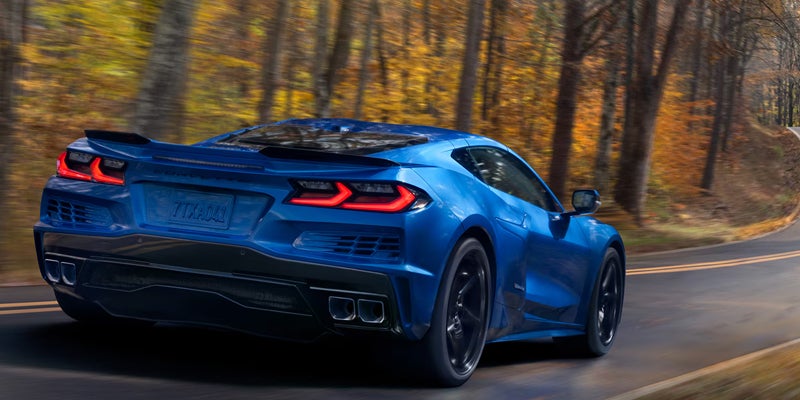
Start With What the E-Ray Is Trying to Do Differently
The Corvette E-Ray is not trying to be a quieter version of the Z06 or a greener version of the Stingray.
Its purpose is more specific. The E-Ray uses electrification to change how power reaches the pavement. The LT2 V8 still gives the car its familiar Corvette heartbeat, while the front electric motor adds a second source of force at the front axle. That combination creates a C8 that feels less defined by rear-tire drama and more defined by how efficiently it can put power down.
That distinction matters because Corvette shoppers often compare trims through horsepower alone. Horsepower matters, but it does not fully explain why the E-Ray feels different from behind the wheel.
A rear-wheel-drive Corvette asks the rear tires to carry the acceleration moment. The E-Ray spreads that demand across both ends of the car during key moments, which changes the launch, throttle response, and grip sensation. The result is not simply more speed. It is speed delivered with a different kind of stability.
That makes the E-Ray especially interesting for shoppers who want a Corvette that feels brutally quick without needing perfect pavement or track-only focus.
The tradeoff is purity. Some drivers want the most traditional performance sensation possible, with rear-drive rotation, high-rev drama, and a more mechanical emotional edge. Others want the Corvette that turns hybrid hardware into repeatable acceleration and all-wheel confidence.
The E-Ray belongs in that second conversation.
How the Front Motor Changes Launch and Throttle Response
The front motor is the part of the E-Ray that changes the car’s character most directly.
Chevrolet pairs the LT2 V8 with an electric drive unit that powers the front axle. During launch, that front motor contributes immediate torque while the rear wheels receive V8 power. Instead of waiting for traction to settle through the rear tires alone, the E-Ray can use the front axle to help pull the car forward.
That is why the car’s acceleration feels different than a traditional rear-wheel-drive C8.
The launch sensation is less about the rear tires fighting for control and more about the whole car hooking up and leaving hard. For a driver, that can make the E-Ray feel almost unnervingly composed for how quickly it moves.
The same idea applies during lower-speed throttle response. Electric torque arrives immediately, so the E-Ray feels alert before the V8 has to do all the work. That can make street driving feel sharper at partial throttle, especially when leaving a corner, entering traffic, or accelerating on less-than-perfect pavement.
The tradeoff is emotional theater.
A Z06 or Stingray can feel more dramatic because the rear tires communicate more of the workload. The E-Ray masks some of that struggle by creating more traction support. For some drivers, that controlled feeling is exactly the point. For others, part of the appeal of a Corvette is feeling the rear-drive chassis work harder underneath them.
The front motor does not make the E-Ray less of a Corvette. It changes the way the car translates power into motion.
Torque Delivery Matters More Than Hybrid Novelty
The word hybrid can send shoppers in the wrong direction when they first study the E-Ray.
This is not a plug-in efficiency play. The E-Ray uses electric power to support performance. The important question is not whether the car feels environmentally different. The important question is whether its torque delivery gives the driver something useful.
In the E-Ray, the front electric motor gives the car a second method of applying force when traction matters. That is why the system earns attention from serious Corvette shoppers. It changes how acceleration feels when the road is damp, cold, uneven, or traction-limited.
During hard acceleration, the driver feels less of the car gathering itself through the rear axle alone. The E-Ray distributes the work in a way that makes the car feel planted and urgent at the same time. That feeling can be more satisfying than a spec sheet suggests because it changes repeatability.
A car that makes a big number once under ideal conditions is different from a car that feels ready to deliver speed again and again across varied surfaces.
That is where torque delivery becomes more important than novelty.
The E-Ray’s hybrid system is worth evaluating through launch consistency, corner exit grip, surface confidence, and how quickly the car responds to small throttle changes. Those are performance questions, not novelty questions.
For shoppers who care about usable acceleration more than traditional purity, the E-Ray creates a serious argument.
E-Ray vs Z06 Is a Driving Character Decision
The E-Ray versus Z06 comparison is not only a numbers conversation.
Both are fast enough that most drivers will never use their full potential on public roads. The difference is how each car creates emotion.
The Z06 is the more intense car. Its high-revving flat-plane crank V8 gives it a sound and character that no hybrid system can imitate. It feels sharper, more exotic, and more connected to track-focused drama. For the driver who wants the engine to dominate the memory of every drive, the Z06 remains difficult to replace.
The E-Ray takes a different path. It is still extremely quick, but it feels more composed. Its speed arrives through traction, instant front motor response, and all-wheel-drive launch confidence. The drama is there, but it is delivered through force and grip instead of only sound and revs.
That creates a real decision tension.
A shopper who wants theater, engine character, track personality, and the feeling of a car that always wants to be driven hard may lean toward Z06. A shopper who wants devastating acceleration, more street usability, and stronger traction across changing weather and pavement may find the E-Ray more rewarding.
The E-Ray can also make sense for drivers who want a Corvette that feels special without demanding a track-focused mindset every time they drive it.
That does not make the E-Ray less serious. It makes it serious in a different way.
The Z06 is the emotional scream. The E-Ray is the controlled strike.
Weight, Balance, and Grip Need to Be Read Together
E-Ray weight is one of the first concerns enthusiasts raise, and it deserves a serious answer.
The hybrid system adds hardware. That means the car carries more mass than a comparable rear-wheel-drive C8 trim. Added weight can change steering feel, braking demands, and how quickly a car transitions when pushed hard.
That concern is valid, but it should not be read by itself.
The E-Ray also gains front axle drive, instant electric torque, standard carbon ceramic brakes, and a chassis setup built around the added performance load. The added mass is part of the equation, but so is the added traction.
A lighter rear-wheel-drive Corvette may feel more delicate and more transparent near the limit. The E-Ray may feel more planted and secure because the front axle contributes to acceleration rather than only steering.
That creates a tradeoff between lightness and traction support.
Drivers who prioritize track precision may be more sensitive to the added weight. Drivers who prioritize street speed, launch control, confidence in poor weather, and corner-exit stability may value the grip advantage more.
Weight distribution also matters because the front motor gives the E-Ray a different sense of balance. The car does not feel like a simple rear-drive Corvette with extra equipment bolted on. It feels like a Corvette calibrated around a different power strategy.
The shopper’s job is to decide whether the added grip is worth the added mass for the way the car will be driven.
Where the E-Ray Makes the Most Sense
The E-Ray makes the most sense for Corvette shoppers who want extreme speed with more usable traction.
It is a strong fit for drivers who care about launch performance, street acceleration, mixed-weather confidence, and a car that feels quick without constantly asking for ideal road conditions. It also suits buyers who want something more advanced than a Stingray but less track-defined than a Z06.
- all-wheel traction
- brutal launch response
- street-focused speed
- mixed weather confidence
- daily usability
- hybrid performance technology
- lower drama during hard acceleration
This is also the Corvette for drivers who want power they can access more often. A car that feels calmer under acceleration can be more enjoyable on real streets because the driver does not have to wait for perfect conditions to feel what makes it special.
The E-Ray does not remove the Corvette attitude. It redirects it through traction and response.
That makes it compelling for shoppers who want the fastest-feeling Corvette for normal roads, not just the most theatrical one on a track.
When the Z06 May Still Be the Better Choice
The Z06 remains the stronger fit for shoppers who want the most visceral naturally aspirated Corvette experience.
Its appeal comes from sound, revs, track intent, and the emotional edge of its engine. If the reason for buying a Corvette is tied to high-rpm drama, exhaust character, and a sharper rear-drive feel, the Z06 is difficult to ignore.
- engine sound
- track days
- high-rpm character
- rear-wheel-drive purity
- sharper emotional intensity
- traditional performance feel
The tradeoff is that the Z06 asks for a different mindset. It feels more specialized and more intense. That is exactly why some buyers love it.
The E-Ray is easier to justify for drivers who want speed that feels more accessible across normal road conditions. The Z06 is easier to justify for drivers who want the car to feel alive through sound and mechanical intensity every time it starts.
Neither choice is weak. They simply reward different instincts.
What Else Should Corvette E-Ray Shoppers Know?
How much horsepower does the Corvette E-Ray make?
The Corvette E-Ray produces 655 combined horsepower from its LT2 V8 and front electric motor system.
What does the E-Ray front motor do?
The front motor powers the front axle and adds immediate torque, supporting launch traction, throttle response, and all-wheel-drive acceleration.
Is the Corvette E-Ray faster than the Z06?
The E-Ray is quicker from 0 to 60 mph based on Chevrolet’s listed acceleration figures, while the Z06 delivers a more track-focused, high-revving driving character.
Is the E-Ray a plug-in hybrid?
No. The E-Ray is not a plug-in hybrid. Its electric system supports performance rather than external charging.
Who should choose the E-Ray over the Z06?
The E-Ray fits shoppers who want all-wheel-drive traction, fast launches, street usability, and hybrid performance response more than high-rpm engine drama.
Does the E-Ray still feel like a Corvette?
Yes. It keeps the mid-engine C8 foundation and V8 power, but it changes the sensation by adding front axle electric torque and all-wheel-drive traction.
(Note: This article focuses on providing valuable information and does not mention specific pricing, for more information about financing and car buying, please reach out to our dealership.)