

When shoppers start researching the Corvette C8, one of the most common questions is what the transaxle actually is and why Chevrolet changed the layout. That question is really about understanding how the Corvette drivetrain works and how that design affects balance, traction, and overall driving feel. The transaxle is not just a technical detail. It is a core part of how the C8 Corvette behaves on the road compared to previous generations.
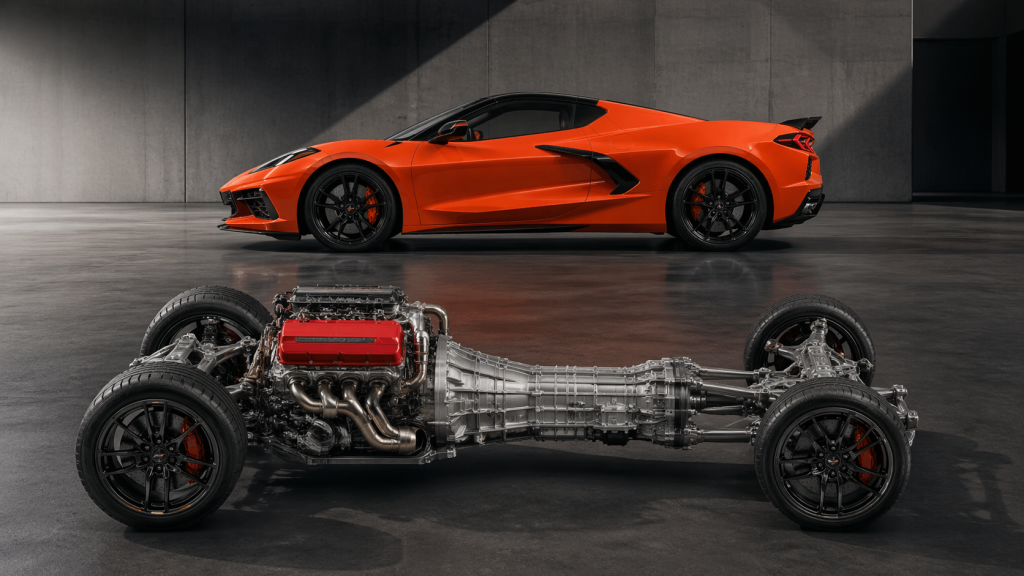
What a Corvette Transaxle Actually Is and How It Works
When buyers ask what a Corvette transaxle is and how it is different from a transmission, they are asking how power moves from the engine to the wheels. A transaxle is a single unit that combines the transmission and the differential into one integrated system.
In a traditional setup, the transmission and differential are separate components connected by a driveshaft. In the Corvette C8 transaxle system, both functions are housed together at the rear of the vehicle. This means the gearbox that changes gears and the differential that distributes power to the rear wheels operate as one unit.
In the C8 Corvette drivetrain, power flows from the mid-mounted engine directly into the rear transaxle. The transaxle then manages gear selection and splits torque between the rear wheels. This reduces the distance power needs to travel and simplifies the drivetrain layout.
For buyers, the implication is not just mechanical efficiency. The Corvette C8 transaxle system changes how quickly and directly power reaches the wheels. That translates into more immediate acceleration response and a more connected driving feel.
Why the Corvette C8 Uses a Rear Transaxle Layout
When shoppers ask why the Corvette C8 uses a rear transaxle layout, they are really asking why Chevrolet moved away from the traditional front engine design. The answer is that the transaxle works as part of a complete mid-engine system designed to improve balance and traction.
In the Corvette C8, the engine is positioned behind the driver and in front of the rear axle. The rear transaxle sits directly behind the engine, creating a compact and centralized drivetrain. This layout concentrates mass closer to the center of the vehicle.
The reason this matters is because weight placement directly affects how a car accelerates, corners, and maintains stability. By pairing a mid-engine position with a rear transaxle, the Corvette C8 achieves a more balanced weight distribution than previous generations.
From a buyer perspective, this is not just about performance numbers. The Corvette C8 layout improves rear wheel traction during acceleration and increases stability during high-speed driving. It also changes how the car feels when entering and exiting corners, making the driving experience more precise and controlled.
How the Transaxle Changes Balance and Weight Distribution
Weight distribution is the way a vehicle’s mass is spread between the front and rear axles. In the Corvette C8, the transaxle plays a direct role in achieving near-balanced weight distribution by placing key drivetrain components toward the rear.
In earlier front-engine Corvettes, even with a rear transaxle in models like the C5, a significant portion of weight remained at the front due to engine placement. In the C8 Corvette, the mid-engine and rear transaxle combination shifts more weight toward the center and rear of the car.
This affects several key driving characteristics:
- Improved traction because more weight sits over the driven rear wheels
- More stable cornering as weight is distributed more evenly
- Reduced front-end load, allowing sharper steering response
The technical reason behind this is that weight distribution influences how tires maintain contact with the road. A balanced layout allows each tire to contribute more evenly to grip and control.
For buyers, the implication is that the Corvette C8 transaxle system contributes directly to confidence behind the wheel. Whether accelerating onto a highway or navigating a curve, the car responds more predictably because its weight is managed more effectively.
C5 Corvette Transaxle vs C8 Corvette Layout Differences
When buyers compare the C5 Corvette transaxle to the C8 Corvette transaxle, they are trying to understand whether this is a completely new concept or an evolution. The C5 Corvette did use a rear transaxle, but the overall layout was fundamentally different.
In the C5 Corvette, the engine was mounted at the front of the vehicle, and a driveshaft connected it to a rear-mounted transaxle. This design improved weight distribution compared to traditional front-engine cars but still retained a front-engine driving character.
In the C8 Corvette, both the engine and the transaxle are located at the rear of the vehicle in a mid-engine configuration. This eliminates the long driveshaft and centralizes the drivetrain mass.
The key differences are:
- C5 Corvette transaxle supports a front-engine layout
- C8 Corvette transaxle is integrated into a mid-engine system
- Power delivery in the C8 is more direct due to reduced drivetrain length
For buyers transitioning from earlier Corvettes, this means the C8 does not just refine the previous formula. It changes the entire driving dynamic. The Corvette C8 feels more balanced and responsive because the drivetrain layout is fundamentally different.
What the Corvette Transaxle Means for Real-World Driving Feel
When shoppers ask whether the Corvette C8 will feel different in everyday driving, they are asking how these engineering changes translate into real use. The transaxle is a key factor in how the car behaves in normal driving conditions.
In the Corvette C8, the rear transaxle contributes to smoother power delivery and more controlled acceleration. Because the drivetrain components are tightly integrated, there is less delay between engine output and wheel response.
This also affects how the car feels in everyday scenarios:
- Acceleration feels more immediate when merging or passing
- The car remains stable during highway driving
- Steering response feels more precise due to balanced weight
The technical reason is that the transaxle reduces drivetrain complexity and improves weight distribution. That combination enhances both performance and predictability.
For buyers, the Corvette C8 transaxle system is not just a track-focused feature. It is a design choice that improves how the car behaves in daily driving situations. Understanding this helps set realistic expectations for how different the C8 will feel compared to earlier Corvettes.
Connect with us
