

The move to a mid-engine layout was the single most consequential engineering decision in Corvette history. For 2026, every Corvette variant benefits from a chassis architecture that fundamentally reshapes how the car accelerates, turns, brakes, and communicates at the limit. This is not a styling evolution or a packaging exercise. It is a structural solution to the physical constraints that defined front-engine Corvettes for decades.
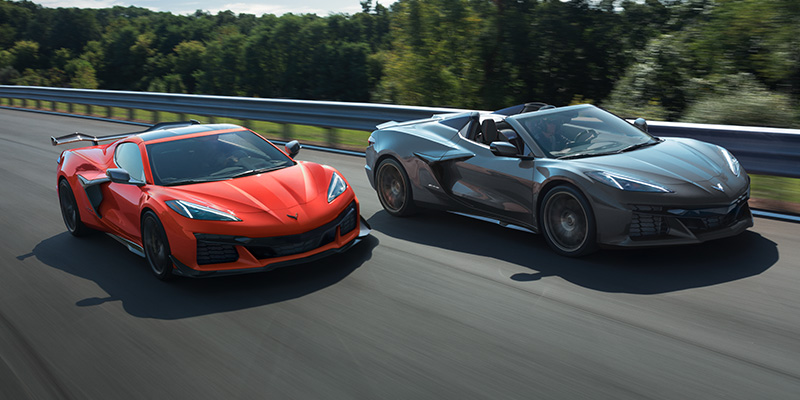
By relocating the engine behind the driver and ahead of the rear axle, Chevrolet changed how mass is distributed, how weight transfers under load, and how the tires are asked to do their work. The result is a Corvette that behaves like a true modern supercar, not just in peak numbers, but in repeatable, controllable performance.
Mid-Engine Corvette Models
Every modern Corvette built on the C8 platform uses a mid-engine layout. This architecture places the engine behind the driver and ahead of the rear axle, forming the foundation for all current and future high-performance Corvette variants.
The following Corvette models are mid-engine:
Corvette Stingray (C8)
Model years 2020 to present
Naturally aspirated V8
Rear-wheel drive
The Stingray introduced the mid-engine platform and serves as the structural and mechanical foundation for all subsequent C8 variants. Its layout established the weight distribution, transaxle placement, and chassis balance that define modern Corvette performance.
Corvette E-Ray (C8)
Model years 2024 to present
Mid-engine V8 paired with a front-mounted electric motor
All-wheel drive
The E-Ray uses the mid-engine layout to enable an electrically driven front axle without compromising rear weight bias. This configuration allows torque vectoring, improved low-speed traction, and enhanced acceleration while maintaining mid-engine balance.
Corvette Z06 (C8)
Model years 2023 to present
Naturally aspirated flat-plane-crank V8
Rear-wheel drive
The Z06 builds on the mid-engine architecture with a higher-revving engine, reinforced cooling systems, and track-focused suspension tuning. Its handling behavior relies heavily on the central mass placement enabled by the mid-engine layout.
Corvette Z07 Package (Z06 option)
Not a standalone model, but a performance package
Retains the same mid-engine configuration
The Z07 package adds high-downforce aerodynamic components, stiffer suspension calibration, and carbon-ceramic brakes. While it does not change engine placement, it pushes the mid-engine platform further toward maximum track capability.
Corvette ZR1 (C8)
Upcoming and confirmed for the C8 platform
Expected twin-turbo V8 configuration
The next-generation ZR1 will also be mid-engine, leveraging the same architecture to support significantly higher power output while maintaining chassis balance and high-speed stability.
Engine Placement and Static Weight Distribution
In a front-engine layout, the heaviest mass sits ahead of the front axle, forcing engineers to manage front tire overload during braking and turn-in. The mid-engine Corvette reverses that problem by concentrating mass near the center of the wheelbase.
The C8 platform carries a rear-biased static weight distribution approaching 60 percent over the rear axle. This allows:
- Reduced front tire load during corner entry
- More consistent contact patch utilization across all four tires
- Improved steering precision under braking
- Less reliance on suspension tricks to mask imbalance
Rather than fighting physics, the chassis works with it.
Polar Moment of Inertia and Chassis Response
One of the most meaningful handling gains from mid-engine architecture is reduction in polar moment of inertia. By clustering mass closer to the car’s center, the Corvette resists rotational lag when changing direction.
On track and aggressive road driving, this produces:
- Faster yaw response during turn-in
- Quicker transitions in left-right sequences
- Reduced delay between steering input and chassis rotation
- More predictable correction behavior when traction limits are approached
This is why the car feels lighter than its curb weight suggests when driven hard.
Traction, Throttle Application, and Corner Exit
Rear weight bias directly improves traction under acceleration. With more mass over the driven wheels, torque application becomes cleaner and more controllable.
Real-world performance benefits include:
- Stronger corner exit acceleration
- Reduced electronic intervention during hard throttle application
- Greater stability when accelerating out of low-speed corners
- Improved launch consistency in both street and track conditions
This advantage compounds as power output increases, which is why the mid-engine platform scales effectively from Stingray through Z06 and beyond.
Braking Stability and Load Transfer Control
During braking, weight shifts forward. In a front-engine car, this exaggerates front axle saturation. In the mid-engine Corvette, braking load transfer results in more even front-to-rear balance.
This provides:
- Greater stability under threshold braking
- Reduced front tire overload during trail braking
- More consistent brake feel over long sessions
- Increased confidence entering corners at speed
Drivers can brake later without destabilizing the chassis.
Suspension Geometry and Packaging Freedom
Removing the engine from the front axle gives engineers far greater freedom in suspension geometry design.
This enables:
- Optimized control arm angles for camber gain
- Reduced understeer bias by design rather than correction
- Improved steering feedback due to reduced mass ahead of the wheels
- Lower hood line supporting better airflow management
The suspension is no longer compensating for poor mass placement. It is free to do its job.
Aerodynamic Balance at Speed
Mid-engine placement also improves aerodynamic balance. With less mass over the nose, the Corvette requires less aggressive front downforce to remain stable.
This results in:
- Better front-to-rear aero balance
- Reduced lift at high speeds
- More predictable high-speed cornering behavior
- Improved integration with underbody airflow and rear diffuser systems
As speed increases, stability improves rather than degrades.
Engineering Tradeoffs and Solutions
Mid-engine layouts introduce challenges such as cooling complexity and rear packaging constraints. Chevrolet addressed these through:
- Side-mounted radiators and dedicated ducting
- Advanced thermal management strategies
- Dual-clutch rear transaxle integration
- Structural reinforcement around the rear subframe
These solutions ensure performance gains do not compromise reliability or drivability.
What Performance Drivers Should Evaluate
Drivers evaluating a 2026 Corvette should focus on how the car behaves under load rather than headline specifications.
Key evaluation points include:
- Steering feel during heavy braking
- Throttle response mid-corner
- Chassis stability during rapid transitions
- Consistency during repeated high-speed use
These are the areas where mid-engine architecture delivers its most meaningful advantages.
Final Perspective
The 2026 Corvette’s mid-engine layout is the foundation of its modern performance identity. By centralizing mass, improving weight distribution, and optimizing traction, Chevrolet engineered a platform that delivers balance, predictability, and control at a level previously unattainable in a front-engine Corvette.
This is not an abstract benefit. It is felt in every braking zone, every corner entry, and every throttle application at the limit.
Connect with us
