


Ross Downing Corvettes

Blog / Hammond Chevrolet Dealer

2025 Corvette Owner Guide: Break-In Procedure, Driving Modes & First-Month Performance Tips

Taking delivery of a 2025 Corvette is more than a milestone purchase. It is the start of a mechanical relationship that rewards disciplined early ownership. While modern Corvettes are engineered with advanced materials, tight tolerances, and extensive factory testing, the first month of driving still plays a critical role in how the vehicle performs long term. Break-in is not about limiting capability. It is about conditioning systems so they deliver consistent, repeatable performance when fully unleashed.

This guide explains how to approach break-in, how to use driving modes effectively, and what habits matter most during the first month of ownership.

Why Break-In Still Matters on a Modern Corvette

Even with precision machining and modern assembly processes, internal components require controlled wear to establish ideal contact surfaces. Break-in allows these parts to mate correctly under varied loads and temperatures.

Key systems affected during break-in include:

  • Piston rings seating against cylinder walls for proper sealing
  • Bearings establishing stable oil film behavior
  • Valvetrain components synchronizing under load
  • Transmission clutches and gears bedding in smoothly

Rushing this process can lead to uneven wear that affects responsiveness and durability over time.

Break-In Mileage and Driving Approach

Rather than focusing on a single mileage number, break-in should be approached as a phase defined by driving behavior. Varying engine speed and load is more beneficial than gentle driving alone.

Best practices during early ownership include:

  • Avoiding sustained engine speeds at a constant rpm
  • Varying throttle input throughout drives
  • Refraining from full-throttle acceleration early on
  • Allowing the engine to reach operating temperature before increasing load

This approach promotes even wear and stable performance characteristics.

RPM Management During Early Miles

High engine speed generates increased friction and heat before components are fully conditioned. Early driving should keep engine speed within moderate ranges while still allowing variation.

RPM-related guidance includes:

  • Avoiding extended operation near redline
  • Letting the engine experience both low and mid-range rpm
  • Using smooth acceleration rather than abrupt throttle inputs
  • Avoiding aggressive downshifts that spike rpm early

Gradual exposure prepares the engine for high-performance operation later.

Transmission Break-In and Shift Behavior

The Corvette transmission is engineered for performance, but it also benefits from early conditioning. Clutch packs and gear interfaces require controlled engagement to develop smooth operation.

Transmission-focused habits include:

  • Smooth throttle application during shifts
  • Avoiding repeated launch-style starts
  • Allowing the transmission to warm fully before spirited driving
  • Letting shift logic adapt naturally over time

These habits support consistent shift quality and long-term reliability.

The Importance of Thermal Cycling

Thermal cycling refers to allowing components to heat up fully and then cool down repeatedly. This process stabilizes materials and relieves internal stress.

Effective thermal cycling includes:

  • Driving long enough to reach full operating temperature
  • Allowing the vehicle to cool between drives
  • Avoiding exclusively short trips during early ownership
  • Mixing city and highway driving

Balanced thermal cycles contribute to long-term mechanical stability.

Understanding Corvette Driving Modes

The 2025 Corvette offers multiple driving modes that adjust throttle response, steering effort, suspension behavior, and drivetrain calibration.

Core driving modes include:

  • Tour mode for smooth, compliant daily driving
  • Sport mode for sharper response and engagement
  • Track mode for maximum performance calibration
  • Custom or Z Mode for personalized settings

Each mode changes how aggressively the vehicle responds to driver inputs.

Driving Mode Strategy During Break-In

During the break-in phase, conservative use of aggressive modes helps manage load while still allowing varied driving conditions.

Recommended early mode use includes:

  • Favoring Tour or Sport for daily driving
  • Using Track mode sparingly early on
  • Avoiding repeated launch control use
  • Gradually increasing performance exposure as mileage accumulates

This strategy balances enjoyment with mechanical care.

Corvette Z Mode Explained for New Owners

Z Mode allows drivers to configure individual performance parameters such as throttle response, suspension stiffness, and steering feel.

Early ownership considerations for Z Mode include:

  • Selecting moderate throttle response initially
  • Avoiding maximum transmission aggressiveness early
  • Gradually increasing settings as the vehicle completes break-in

Z Mode offers flexibility without forcing an all-or-nothing performance profile.

First-Month Driving Habits That Influence Long-Term Performance

Small habits during the first month have a lasting impact on how the Corvette feels and responds.

Positive early habits include:

  • Smooth throttle transitions
  • Progressive braking rather than abrupt stops
  • Controlled steering inputs
  • Paying attention to vehicle feedback

These behaviors promote balanced wear across systems.

When Track Driving Should Begin

Track driving places sustained, extreme demands on the engine, transmission, brakes, and cooling systems. It should be postponed until break-in is complete and systems are fully conditioned.

Indicators that the Corvette is track-ready include:

  • Completion of initial break-in mileage
  • Stable fluid temperatures under spirited driving
  • Consistent throttle and shift response
  • Confidence in braking performance

Waiting ensures performance remains consistent lap after lap.

Early Maintenance Awareness

While major service may not occur in the first month, owners should remain attentive to vehicle condition.

Early ownership checks include:

  • Monitoring fluid levels
  • Observing warning indicators or messages
  • Listening for abnormal noises
  • Noting changes in drivability or shift behavior

Addressing concerns early supports long-term reliability.

What New Corvette Owners Should Evaluate

During the first month, owners should evaluate:

  • Engine responsiveness as mileage increases
  • Transmission smoothness and consistency
  • Brake feel under varied conditions
  • Ride quality and chassis balance

This awareness helps owners understand how the vehicle evolves through break-in.

Final Perspective on First-Month Corvette Ownership

The 2025 Corvette is engineered for extreme performance, but that capability is best realized through thoughtful early ownership. Break-in is not about restraint. It is about preparation. By managing load, using driving modes strategically, and building smooth habits, owners ensure the Corvette delivers its full potential when it matters most.

A properly conditioned Corvette rewards its owner with confidence, consistency, and durability that extend from daily driving to track-level performance.

Posted in:

Related Posts

Corvette Specific Service: Track Day Inspection Guide

A Corvette driven hard on a track faces stress levels far beyond daily street use. For that reason, corvette specific service matters more than a routine oil change. Track driving raises brake temperatures and loads suspension bushings hard. Additionally, it cycles tires through heat ranges a daily commute never reaches. A shop that understands these stresses can catch wear before it causes a failure. This guide covers what to check before a track day. It also covers what changes mechanically on track, what to inspect right after, and why brake fluid choice carries real weight. What Changes Mechanically During a Track Session? This question matters because the answer explains every inspection point that follows. On track, brake rotors and pads reach temperatures far above street driving. Repeated hard stops can push that heat above 1,000 degrees Fahrenheit. That heat transfers into the brake fluid inside the calipers. If the fluid boils, the pedal can go soft or fail entirely. At the same time, suspension bushings and ball joints absorb cornering loads that exceed anything found on a public road. Tires heat cycle several times per session, and that changes both pressure and grip. Because these stresses build across a full track day, the car needs an inspection process that matches what it absorbed. more The Brake Fluid Requirement Most Owners Miss Stock Corvette brake fluid usually meets a DOT 3 or DOT 4 specification. That fluid carries a wet boiling point in the range of 280 to 311 degrees Fahrenheit. Track temperatures regularly exceed that threshold. Stock fluid can boil during hard braking and pull air into the lines. A DOT 5.1 fluid raises the wet boiling point closer to 370 degrees Fahrenheit. That gap gives real margin during repeated braking events. DOT 5.1 fluid is also more moisture sensitive over the calendar year. For this reason, it needs a flush schedule more frequent than typical street use. Given that, a specialty shop will know the correct GM approved fluid for each Corvette generation. That shop can also verify the system was bled with no trapped air. Skipping this step risks a soft pedal exactly when stopping power matters most. Post Track Inspection: What Should Get Checked After Most track prep content focuses heavily on what to check before a session. However, the inspection after the car comes off track carries equal weight. Heat cycling and repeated loading can reveal wear that stayed hidden during the pre track check. Catching that wear early stops a small issue from becoming a costly repair. The list below covers the points a specialty shop checks most closely. Brake pads and rotors need a check for uneven wear or hairline cracking. Extreme heat can weaken rotor integrity even when pad material still looks fine. Additionally, wheel and suspension fasteners should get retorqued to factory specification. Heat cycling and cornering loads can work bolts loose without any feeling reaching the seat. Furthermore, tire tread needs a check for chunking or uneven wear. Aggressive heat cycling can break down rubber faster than tread depth alone suggests. Fluid levels across the brake, coolant, and differential lines need a recheck. A hot session can reveal a slow leak that street driving never exposed. Beyond the visual check, a specialty shop will pull the wheels to inspect brake lines and suspension parts. Still, those parts stay hidden from underneath the car during a quick glance. That deeper look matters because a stress crack in a line can grow slowly and go unnoticed until it fails. Why Specialty Knowledge Changes the Outcome A general repair shop can handle an oil change or a battery swap without trouble. However, corvette specific service calls for familiarity with the mid engine layout and the track oriented brake setup. As a result, a technician unfamiliar with the platform might miss a wear pattern that a Corvette specialist would catch right away. That gap exists because bushings, fluid types, and fastener specs differ from a typical sedan. For this reason, searching corvette repair shop or corvette shops near me points owners toward technicians who already know this platform. That familiarity carries even more weight on newer generations like the C8. The mid engine layout on the C8 shifts which parts absorb the most stress. Building a Service Routine Around Track Use A Corvette that sees regular track time needs a service routine built around that use. However, a generic schedule pulled from the owner's manual will not catch everything. Establishing a relationship with a shop that understands corvette specific service means inspection points get caught on a consistent basis. That consistency removes the burden of the owner remembering every check after each session. It also protects the car's mechanical health across years of ownership, since small issues caught early rarely turn into expensive repairs. Owners who treat track use as a normal part of ownership gain the most from a shop relationship built on that understanding. The outcome is a Corvette that stays ready for the next session without surprises showing up on the drive home.

LT2 vs LT6 Corvette Engine Differences Explained

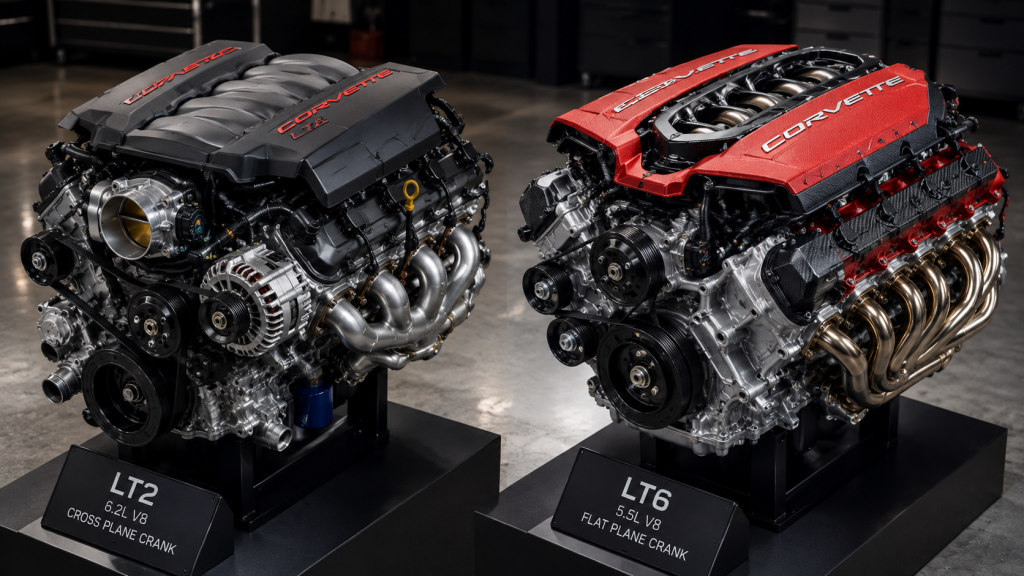
The LT2 vs LT6 Corvette engine discussion starts long before horsepower numbers enter the conversation, because these two V8 layouts change how the car sounds, reacts, shifts, and communicates with the driver. Buyers researching the Corvette Stingray and Corvette Z06 usually begin with output figures, quarter mile times, or trim comparisons, but the larger distinction comes from engine architecture itself. Chevrolet engineered these powerplants with completely different personalities in mind. One delivers immediate torque with a deep, muscular cadence. The other builds intensity through rev speed, airflow, and razor-sharp response. Understanding how those traits appear behind the wheel creates a much clearer picture of which Corvette belongs in your garage. Why LT2 and LT6 Feel Different Before Full Throttle The LT2 in the Corvette Stingray uses a traditional cross plane crankshaft pushrod V8 layout. That configuration creates a smoother idle character, stronger low RPM torque delivery, and a heavier exhaust pulse rhythm. Even before aggressive acceleration, the Stingray feels settled and substantial. Small throttle inputs create immediate forward movement because torque arrives earlier in the rev range. The LT6 in the Corvette Z06 approaches engine response very differently. Chevrolet developed this naturally aspirated 5.5 liter V8 around rapid airflow movement and high RPM breathing. Instead of emphasizing low-speed shove, the LT6 builds urgency through rev speed and throttle sharpness. Press the accelerator lightly in a Z06 and the engine climbs through RPM far faster than the Stingray. Drivers notice that change immediately during merges, lane changes, and corner exits. That difference alters how the dual clutch transmission behaves as well. The Stingray transmission tuning keeps shifts calm and relaxed during casual driving. Gear changes happen lower in the RPM range because the LT2 produces strong usable torque without needing aggressive downshifts. The Z06 behaves differently because the LT6 wants to remain active higher in the rev range. Drivers may notice: more More frequent downshifts during acceleration Sharper throttle sensitivity during partial pedal inputs Faster RPM climbing between shifts Greater engine sound presence during normal driving Those differences create two distinct personalities before either car approaches maximum acceleration. What Is a Flat Plane Crank and Why Does It Matter? A flat plane crankshaft changes the firing sequence and rotational balance inside the engine. In the LT6, crankshaft journals sit 180 degrees apart instead of the cross shaped layout used in the LT2. That design changes airflow rhythm, vibration character, and exhaust pulse timing. The result is an engine that revs more freely and responds more quickly to throttle movement. Rotating mass inside the LT6 changes direction with less inertia, allowing RPM to climb rapidly. That sharper response becomes one of the defining traits of the Corvette Z06. The tradeoff appears in engine smoothness. Cross plane crank V8 engines like the LT2 naturally balance vibrations more effectively, producing the deeper rumble associated with traditional American V8 sound. Flat plane crank engines create a higher frequency exhaust note with more mechanical sharpness because firing pulses alternate differently between cylinder banks. That architecture also changes breathing efficiency at higher RPM. The LT6 uses dual overhead camshaft valvetrain engineering to support airflow stability as engine speed climbs toward its extremely high redline. The LT2 pushrod layout prioritizes compact packaging and strong torque delivery lower in the powerband. Competitor articles usually stop at “flat plane crank equals exotic sound,” but the larger mechanical story involves airflow timing, crankshaft inertia, and combustion rhythm. From the driver seat, that translates into: Faster rev transitions More urgent acceleration feel Higher pitch exhaust tone Increased sensitivity during throttle modulation More active engine personality during spirited driving Street Driving and Highway Cruising Reveal Different Priorities The Corvette Stingray and Corvette Z06 separate themselves most clearly during ordinary driving situations. Highway cruising, stoplight acceleration, parking lot maneuvering, and suburban commuting expose how differently these engines interact with daily traffic rhythm. The LT2 settles into lower RPM cruising naturally. Its torque curve supports relaxed acceleration without requiring aggressive pedal movement. During highway passing situations, the Stingray can accelerate strongly without dramatic transmission downshifts or elevated engine noise. That creates a calmer grand touring personality. The LT6 introduces more sensory intensity into every interaction. Because power builds progressively through RPM, the engine remains more active during acceleration events. Drivers hear intake sound, exhaust sharpness, and valvetrain activity more prominently throughout the rev range. This does not make the Z06 difficult to drive. Instead, it creates a more engaged relationship between driver inputs and engine reaction. Buyers considering daily ownership should evaluate: Desired exhaust volume during commuting Preference for low RPM torque versus high RPM excitement Interest in track-focused response tuning Sensitivity to sharper throttle calibration Highway cruising priorities Some drivers immediately connect with the Z06 because every acceleration event feels dramatic and urgent. Others prefer the Stingray because it balances speed with calmer drivability. Why the LT6 Sounds Completely Different The sound distinction between these Corvettes originates directly from firing order rhythm and airflow behavior. Cross plane crank V8 engines create overlapping exhaust pulses that produce the traditional deep American V8 rumble. The LT2 delivers that familiar cadence with strong low-frequency resonance and slower exhaust rhythm. The LT6 changes that acoustic structure entirely. Flat plane crank timing spaces exhaust pulses more evenly, producing a sharper, smoother, higher-frequency sound profile. As RPM climbs, the engine develops a layered mechanical tone closer to endurance racing engines than traditional pushrod V8 muscle cars. Air intake tuning contributes heavily as well. Chevrolet engineered the LT6 intake path to support sustained high RPM airflow stability. Drivers hear that airflow movement increase dramatically as revs climb, adding to the engine’s exotic character. The emotional distinction becomes substantial during acceleration: LT2 delivers heavier bass-driven acceleration sound LT6 produces sharper rising pitch intensity Stingray emphasizes torque sensation Z06 emphasizes RPM escalation and urgency That difference shapes emotional connection more than raw output numbers for many buyers. Choosing Corvette Character Instead of Chasing Numbers The LT2 vs LT6 Corvette engine debate becomes easier once buyers stop viewing the decision as “base versus upgraded.” These engines pursue entirely different emotional goals. The Corvette Stingray focuses on broad accessibility, deep torque delivery, and balanced drivability. Its pushrod V8 creates a familiar American sports car rhythm with enough refinement to feel composed during long highway drives or daily commuting. The Corvette Z06 introduces a far more intense relationship between engine speed and driver input. The flat plane crank LT6 transforms the car into something sharper, louder, and more reactive. It rewards aggressive throttle application and high RPM driving in ways the Stingray intentionally does not pursue. Neither setup replaces the other. Instead, Chevrolet engineered two separate interpretations of Corvette character: One centered around muscular torque and composure One centered around rev speed, sharpness, and sensory drama Drivers choosing between them should focus less on horsepower hierarchy and more on which engine personality matches the kind of driving they want to remember after the road straightens out.

Corvette Museum Delivery vs Standard Pickup Guide

Corvette Museum Delivery has become part of the ownership story for many C8 buyers, but the right acquisition path depends less on prestige and more on how you personally connect to the car before the first drive home. Some owners want the moment to feel immersive from the beginning, complete with plant history, museum orientation, and delivery ceremony. Others want a cleaner process centered around getting behind the wheel as quickly as possible. That difference shapes how buyers approach ordering, build tracking, scheduling, and even how they remember the car years later. A Corvette purchase is emotional by nature, so the acquisition path deserves the same level of consideration as trim selection, engine choice, or package configuration. Why Corvette Buyers Approach Delivery Differently The reason Corvette Museum Delivery generates so much attention is because the car itself carries enthusiast identity long before ownership begins. Buyers are not simply choosing transportation. They are entering a community with strong ties to engineering history, motorsports heritage, and personalization culture. That changes how acquisition decisions are viewed. Some buyers treat delivery as the final administrative step before driving home. Others see it as the opening chapter of ownership itself. That distinction explains why Museum Delivery resonates strongly with some Corvette customers while feeling unnecessary to others. Buyers leaning toward the Bowling Green route usually value: more connection to Corvette manufacturing history visual access to the assembly environment commemorative ownership moments deeper involvement in the ordering process A standard dealership pickup appeals to a different ownership mindset. Those buyers may still be passionate enthusiasts, but their focus centers more heavily on immediacy, scheduling simplicity, or avoiding additional travel coordination. Neither approach is more correct. The decision becomes more personal once buyers understand what they emotionally expect from the acquisition process itself. Corvette ownership culture also amplifies this divide online. Build updates, delivery photos, museum ceremonies, and plant tours are heavily shared across forums and enthusiast communities. That visibility can create pressure to view Museum Delivery as the “proper” enthusiast choice. In practice, satisfaction usually comes from selecting the process that naturally matches the buyer’s personality and pacing preferences. How Museum Delivery Changes the Start of Ownership What is Corvette Museum Delivery? It is a factory connected acquisition experience where buyers take delivery near the National Corvette Museum in Bowling Green after their vehicle completes production. The process transforms vehicle pickup into a destination-centered ownership event. That emotional shift starts before arrival. Buyers frequently monitor production status updates more closely once Museum Delivery is scheduled because the trip itself becomes tied to assembly timing. VIN assignment, production sequencing, and transport coordination suddenly feel more personal. The experience changes ownership psychology in several ways: anticipation stretches longer due to travel planning production milestones feel more emotionally important buyers become more attached before first drive the car gains a story before accumulating mileage A Corvette Stingray buyer choosing Museum Delivery may value the historical connection and ceremonial pacing. A Z06 customer may place heavier emphasis on LT6 engineering heritage and assembly curiosity. E-Ray buyers frequently approach the experience through innovation interest and milestone ownership. The delivery environment reinforces those emotional narratives. The plant connection also changes how owners perceive the vehicle afterward. Buyers who tour the facility or spend time immersed in Corvette history usually develop stronger awareness of production detail, sequencing complexity, and manufacturing craftsmanship. That added context shapes ownership pride differently than a traditional handoff at the dealership. Museum Delivery also slows the acquisition moment intentionally. Instead of signing paperwork and immediately transitioning into traffic, the owner spends additional time focusing entirely on the car. That pacing creates a stronger memory imprint for buyers who value milestone experiences. Does Building a Corvette Create a Different Ownership Connection? Yes. Build participation changes emotional investment because the buyer becomes attached to the configuration process long before delivery occurs. Corvette ordering is highly personalized, and that personalization creates anticipation that grows throughout production tracking. The ordering process becomes immersive once buyers start monitoring: allocation acceptance status code progression VIN assignment production scheduling assembly completion transportation updates Those milestones sound administrative on the surface, but enthusiast buyers treat them as emotional checkpoints. A custom-built Z06 with carefully selected interior colors, wheel configurations, aero packages, and seating combinations feels emotionally tied to the buyer before the vehicle physically arrives. That emotional investment becomes stronger when paired with Museum Delivery because the owner sees the acquisition as a continuation of the build journey instead of a separate transaction. The buyer mentally connects configuration decisions, assembly visibility, and final pickup into one continuous ownership story. Standard pickup buyers can still develop that same attachment through build tracking, but the emotional pacing changes. The acquisition becomes more compressed. Some owners prefer that approach because it keeps excitement focused on driving rather than ceremony. This distinction matters most for buyers debating between inventory purchase and factory ordering. Enthusiasts who enjoy personalization, production curiosity, and milestone tracking usually gain more satisfaction from a custom build path. Buyers prioritizing immediacy may find inventory acquisition more rewarding because the emotional payoff arrives sooner. Why Standard Pickup Still Fits Many Corvette Buyers A standard dealership delivery removes several layers of coordination that Museum Delivery introduces. Travel planning, hotel scheduling, timing flexibility, and transportation logistics all become part of the acquisition process with the Bowling Green route. That added complexity does not appeal to every buyer. Some Corvette owners simply want: shorter acquisition timelines easier scheduling less travel coordination immediate local support access faster transition into ownership This becomes more noticeable for repeat Corvette owners. Someone purchasing their third or fourth Corvette may already feel deeply connected to the brand and no longer prioritize ceremonial delivery. Their satisfaction may come from configuration selection and driving engagement instead. Distance also changes the equation. Buyers traveling across multiple states for Museum Delivery must account for weather timing, road break in planning, return travel fatigue, and scheduling unpredictability tied to production movement. Some owners enjoy that added planning because it extends anticipation. Others view it as unnecessary friction. There is also an understated emotional advantage to local pickup. Taking delivery from the dealership where the ordering relationship was built creates a more personal hometown connection for certain buyers. Some owners value seeing the car prepared locally by the team that guided them through the ordering process. The important point is that ownership excitement is not measured by delivery complexity. A standard pickup does not diminish enthusiasm. For many Corvette customers, the strongest emotional moment still happens the instant the engine starts for the first drive home. Choosing the Corvette Ownership Journey That Fits You Museum Delivery works best for buyers who value memory creation alongside vehicle ownership. Those customers usually enjoy the anticipation phase, production tracking process, and enthusiast immersion tied to Bowling Green. The experience feels less transactional and more personal from beginning to end. Standard pickup fits buyers who prioritize immediacy, simplicity, and cleaner logistics. That path keeps the focus concentrated on the driving relationship itself without adding travel coordination or ceremonial pacing. The right answer depends on how you emotionally approach ownership: Do you enjoy the process as much as the product? Does manufacturing history matter to you? Will the delivery memory stay important years later? Do you enjoy production tracking and configuration involvement? Would additional travel increase excitement or create stress? Corvette buyers frequently spend months researching trims, engines, wheel designs, and appearance packages. Delivery style deserves similar attention because it shapes the emotional tone of ownership before the odometer meaningfully changes. Whether the keys are handed over in Bowling Green or at your local dealership, the strongest ownership outcome comes from choosing the process that naturally fits how you connect with the car.